This blog aims to explore the empty ground between the academic history of Early Modern England (1500-1800) and insights derived from family history, a field perhaps understandably disdained by professional historians. 1
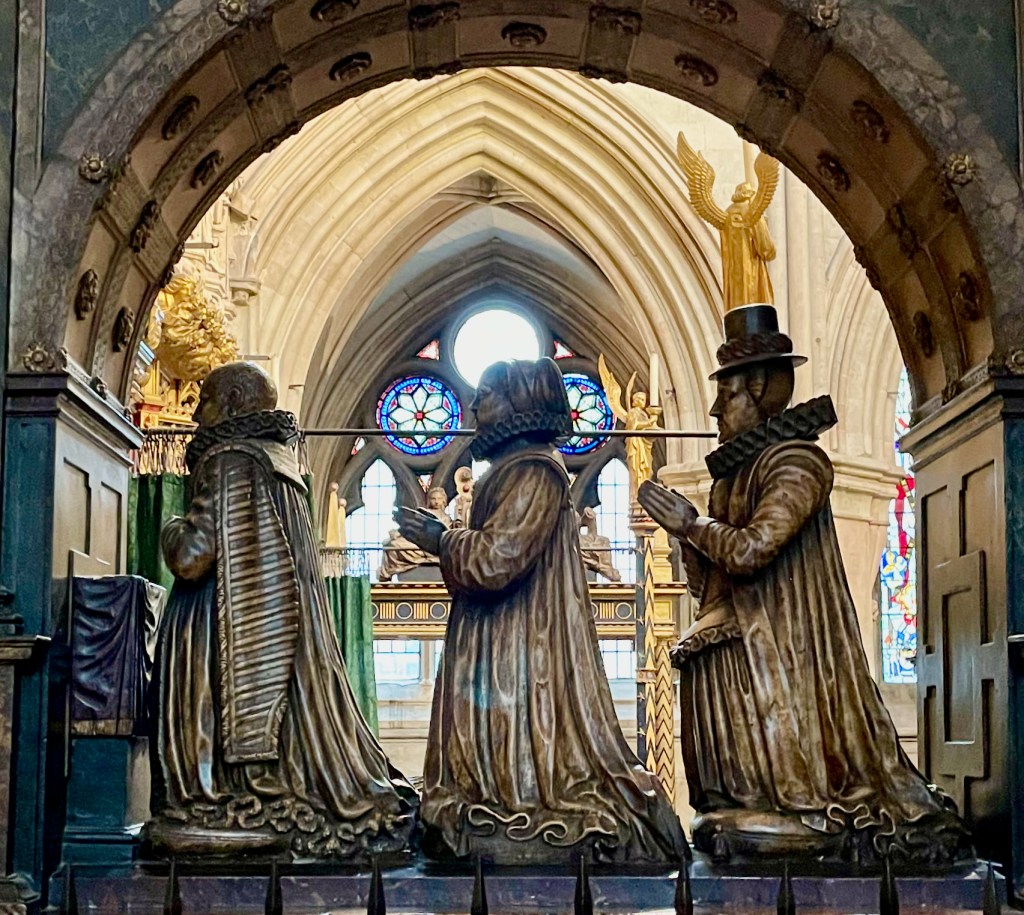
The Humble Monument in the chancel of Southwark St Saviour. Richard Humble, buried 30 April 1616, was a vintner, who declined Aldermanship of the City of London. His second wife, Isabel, was the daughter of Robert Kitchenman, gentleman, of He[l]msley, Yorkshire. 2
The Kitchingmans (spellings vary) were a family mostly of the middling sort, mainly located in Yorkshire. They left behind a remarkable document trail of over 3,000 parish records, wills, property transactions, apprenticeship and taxation records, along with many court cases. These records are fragmented before the seventeenth century but increasingly cohesive thereafter. 3
Moreover, their unusual surname makes it possible to join the dots of extensive kinship connections across time and space. In contrast to orthodox views, the evidence is clear that kinship mattered for the Kitchingmans, in different locations and over the long term. 4
This blog is not intended to be a comprehensive record of a single family’s genealogy – ‘The Pulleyns of Yorkshire’ is one example of many similar, meticulous volumes (self) published by antiquarians. Such accounts of who begat whom are often as exhausting as they are exhaustive, lacking in appeal for the general reader and devoid of historical context. 5
Rather, my aim is to pass on some of the more interesting stories about the Kitchingman family and their kin, while hopefully shedding a little light on matters of wider historiographical concern.
References
1 B. Waddell, ‘History from below: today and tomorrow’, https://manyheadedmonster.com/2013/07/29/brodie-waddell-history-from-below-today-and-tomorrow/, argues that family history is a promising route forward for “doing history” from below, although its main contribution would seem to be to the funding of archive digitisation.
J. de Groot, ‘On Genealogy’ , The Public Historian, Vol. 37, No. 3, pp. 102–127 (August 2015), explores the similarities and differences between amateur investigation and professional gatekeepers to the past.
E.S Mills, ‘Bridging the Historic Divide: Family History and “Academic” History’, Papers from the Midwestern Roots Conference. Indiana University Department of History, (2007), https://www.historicpathways.com/download/bridghisdivideivide.pdf suggests that the real divide is not between historians and genealogists, who use many of the same sources and methodologies, but between professionals and “web grown” family tree gatherers.
See also J. Laite. ‘Reflections on the Family History Workshops’, (London 2021), https://historianscollaborate.com/family-history-workshops/ for discussion of the beginnings of a meaningful conversation between academic and family history.
2 The late Victorian restoration of this monument led to the inscription being incorrectly changed to “daughter of Richard Hinclimmon of Henley in the county of York”. “Kitchenman” is supported by: the Southwark St Saviour Parish Register recording their marriage by licence on 19 December 1604; by Society of Genealogists, ‘Boyd’s Inhabitants of London’; as well as by the transcription in J. Strype, A Survey of the Cities of London and Westminister, Borough of Southwark, and Parts Adjacent, (London, 1735), Book IV, Chapter 1, p.12, https://www.dhi.ac.uk/strype/TransformServlet?page=book4_012&display=normal
Robert Kitchenman left a scant trail in the records. In 1578, Cuthbert Kytchinman son of Robert and Dorothie was baptised at Helmsley. There is no record of Isobel’s baptism but she may have been Cuthbert’s brother. A Robert was buried in 1579, with a Dorothie (re)marrying the following year: North Yorkshire County Record Office, PR/HEL 1/2, f.87, Parish Register of Helmsley 1575-1653. In 1616, a Kitchenman of Helmsley was granted arms by Camden: W.H. Rylands (ed.), Grantees of arms named in docquets and patents to the end of the seventeenth century, (London, 1915), p.146. https://archive.org/details/granteesofarmsna00fost/page/145/mode/1up
For Richard Humble’s biography, see also: A. B. Beaven, The Aldermen of the City of London, (London, 1908), p.158; W. C. Metcalfe, The Visitations of Essex 1612, https://archive.org/details/visittionsofess13metc/mode/1up?q=humble;
London Metropolitan Archives, ‘Vestry Minutes of St Saviour Southwark, 1582-1628’, https://stsaviour.folger.edu/vestry-minutes-450.html.
3 There is an extensive literature on the middling sort. I hope to post about how that intersects with Kitchingman family history in due course. See H. R. French, The Middle Sort of People in Provincial England, 1600-1750, (Oxford Scholarship Online, September 2007), as a starting point.
A. MacFarlane et al, ‘Reconstructing Historic Communites’, (London, 1977). http://www.alanmacfarlane.com/reconstructing/contents.htm remains a useful guide to sources for the family, as well as academic, historian, including the pitfalls and ambiguity of the data. The ideal is to use all available sources.
4 Again, I intend to post separately on the historiography of kinship. In the meantime, see the discussions in D. Cressy, ‘Kinship and Kin Interaction in Early Modern England’, Past & Present, 213 (November 1986), and N. Tadmor, ‘Early Modern Kinship in the Long Run’, Continuity and Change 25 1 (2010), https://www.jstor.org/stable/650979?seq=1&cid=pdf-reference#references_tab_contents.
5 C. Pullein, The Pulleyns of Yorkshire, (London, 1915) https://archive.org/details/pulleynsofyorksh00pull
 Early Modern Kinship