Four houses in Carlton Husthwaite
If you had walked through the village of Carlton Husthwaite in the North Riding of Yorkshire in 1690, you would have noticed four recently-built, substantial houses.
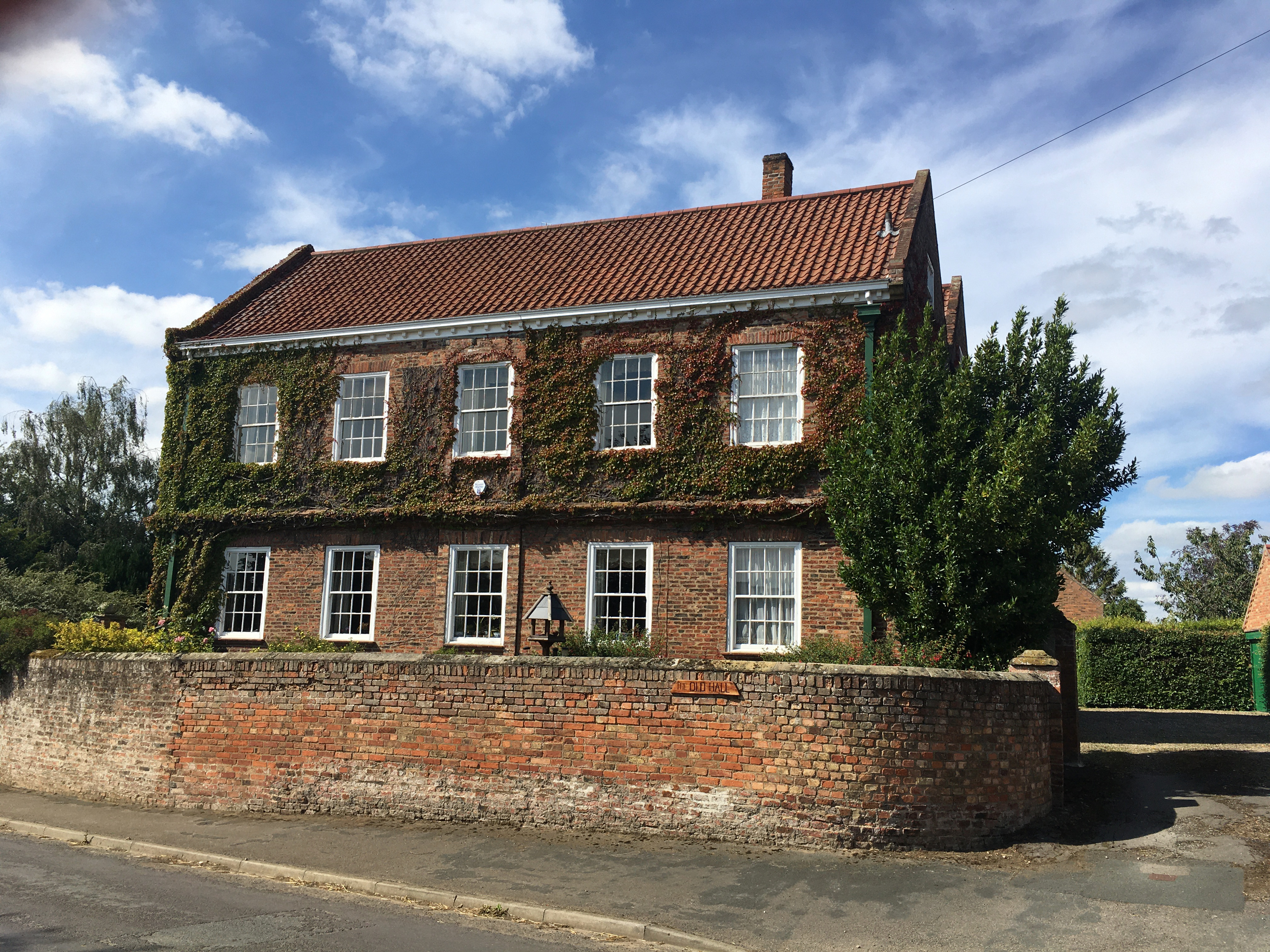
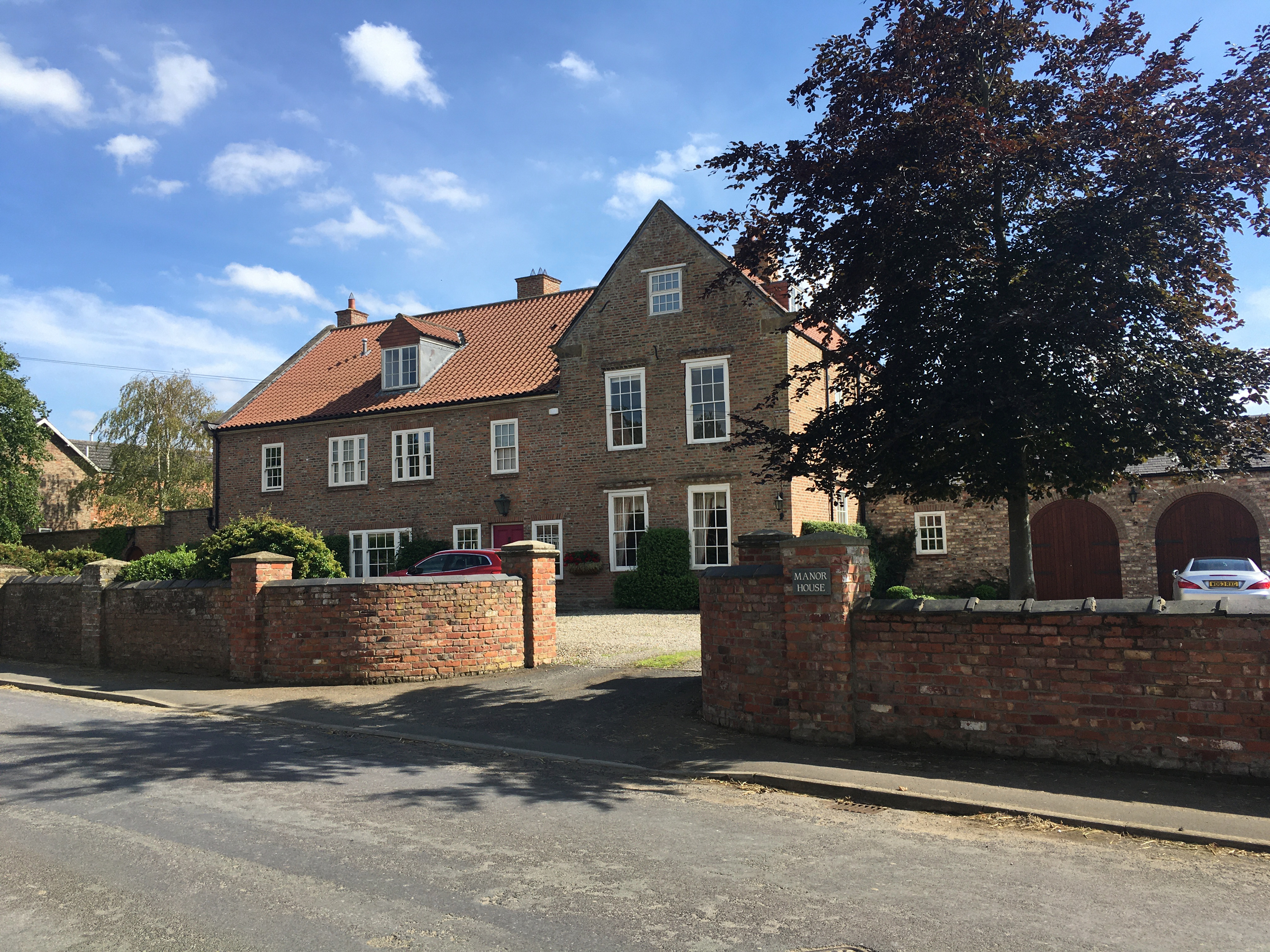
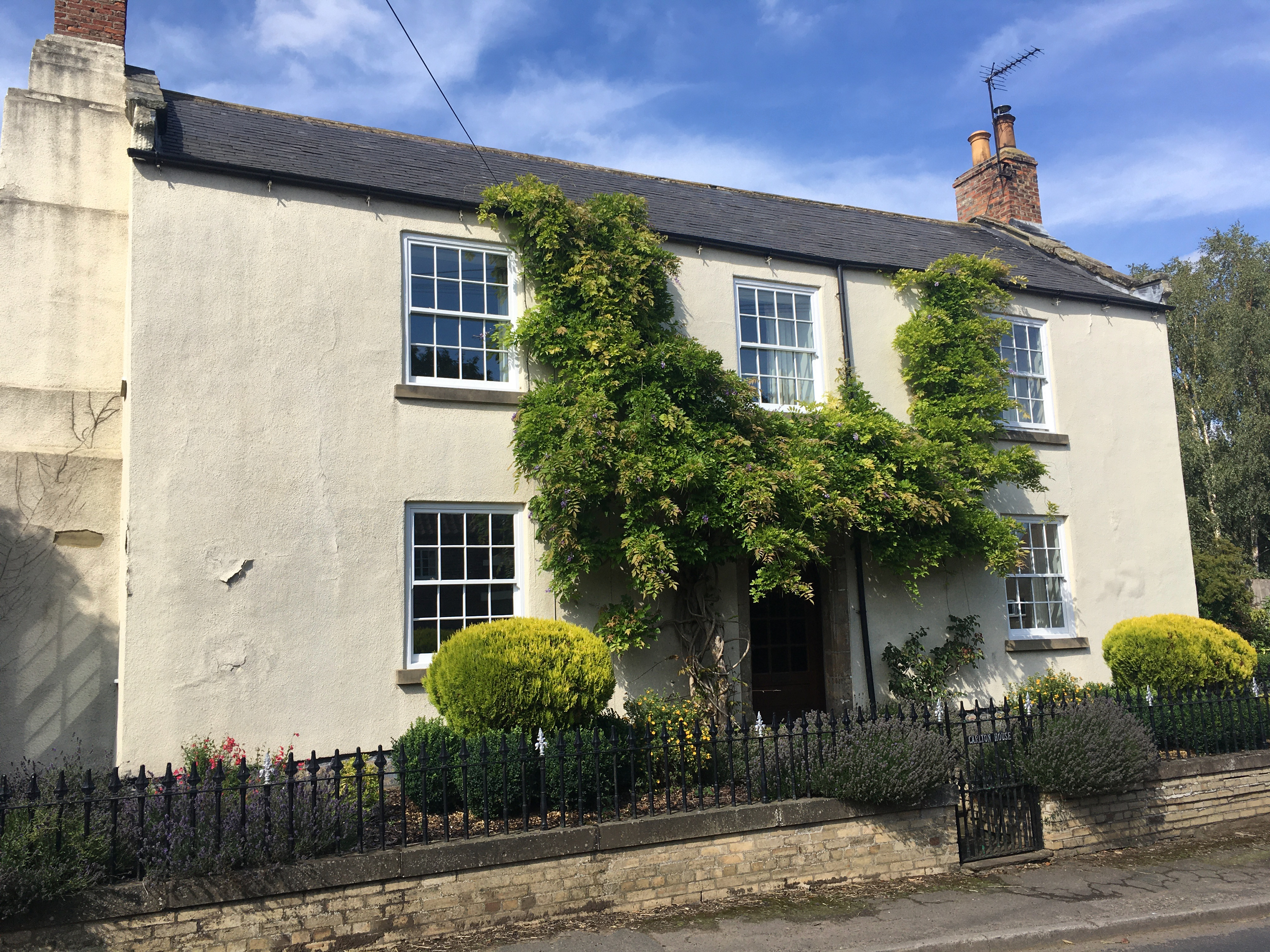
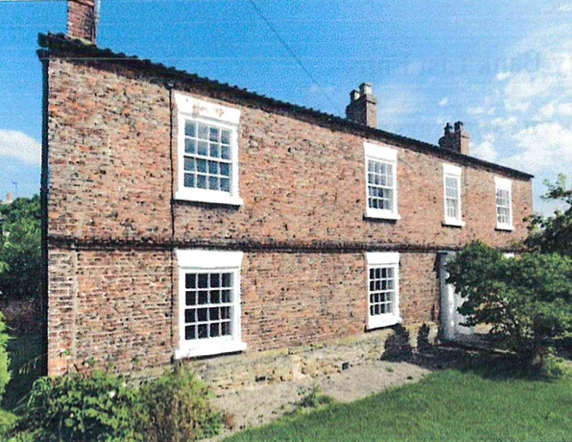
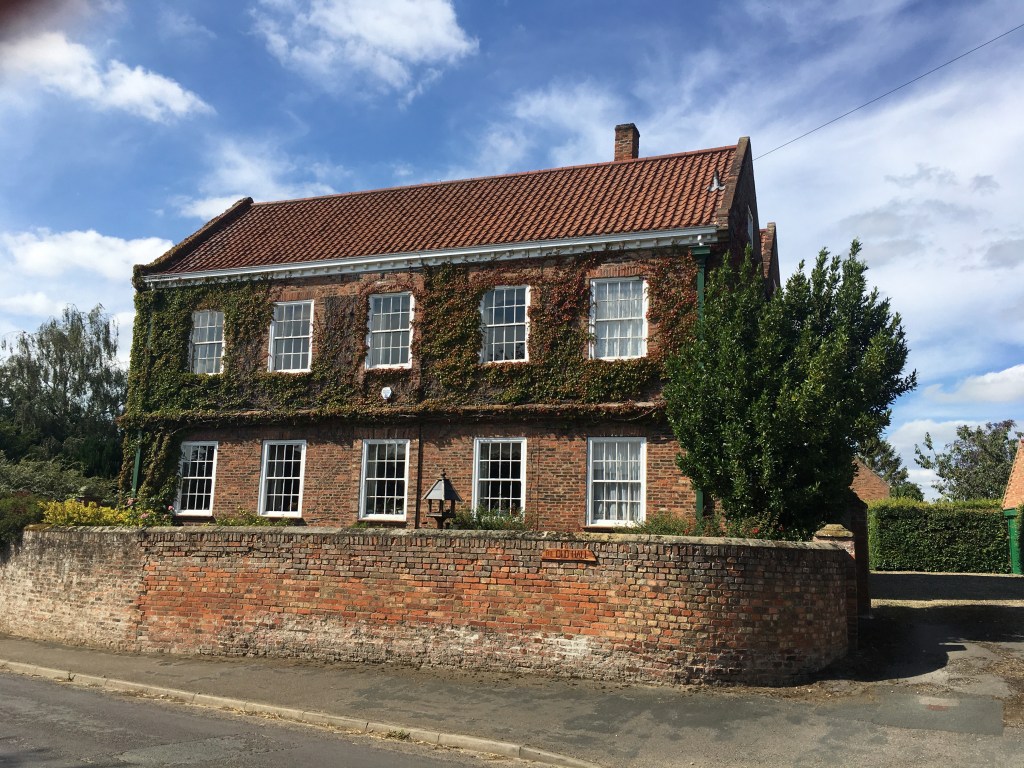
Clockwise from top left: ‘Old Hall’; ‘Manor House’; ‘Sunny Bank’; ‘Carlton House’.
The houses were not named until the nineteenth century.
What we now call the ‘Manor House’ belonged to William Kitchingman the Elder; the ‘Old Hall’ to William Kitchingman the Younger; ‘Carlton House’ to Bryan Kitchingman; ‘Sunny Bank’ to George Cooper, husband of Margaret Kitchingman. 1
Where did these Kitchingmans come from? How did they come to occupy such prominent positions in the village?
In the seventeenth century, when people spoke of “their country”, they did not mean England. Rather, as Keith Wrightson has it, they were referring to “a distinctive area, a landscape, a local culture” to which they belonged. 2
The Kitchingmans’ country was not confined to Carlton but included land they farmed in the neighbouring villages and hamlets of Bagby, Balk, Birdforth, Kilburn, Raskelf, Thirkleby and Wildon Grange. All were within a short distance of the Great North Road. Arguably, this helped extend their country to the whole Vale of York and the city itself. 3
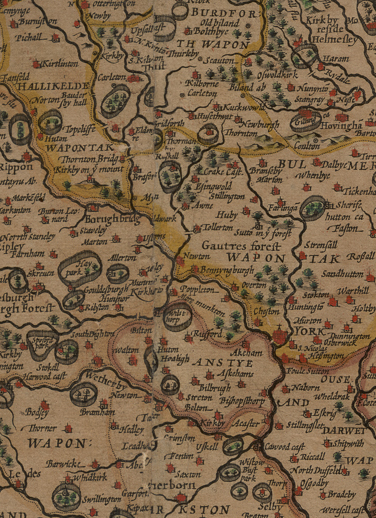
John Speed, ‘The Theatre of the Empire of Great Britain’, Yorkshire (extract), 1611.
Cambridge University Library. Copyright University of Cambridge, licensed under CC-BY-NC 3.0.
Three of the four in Carlton were grandchildren of William Kitchingman alias Cleveland of Thirkleby. He was a yeoman, a farmer, below the ranks of the gentry but above the “common sort”. The records show him acquiring freehold land, serving on the jury in the Quarter Sessions and as a church warden. He was also fined £10 for failing to take the oath of knighthood at King Charles I’s coronation. Distraint of Knighthood was a taxation scam: summons were issued long after it was too late to reach London and levied on anyone able to pay. He also fell foul of various courts for failing to ring his pigs, over-stretching linen cloth, excessive malt making and calling one of his neighbours a “whore master”. 4
Despite these ups and downs, William did well enough to provide amply for his seven sons.
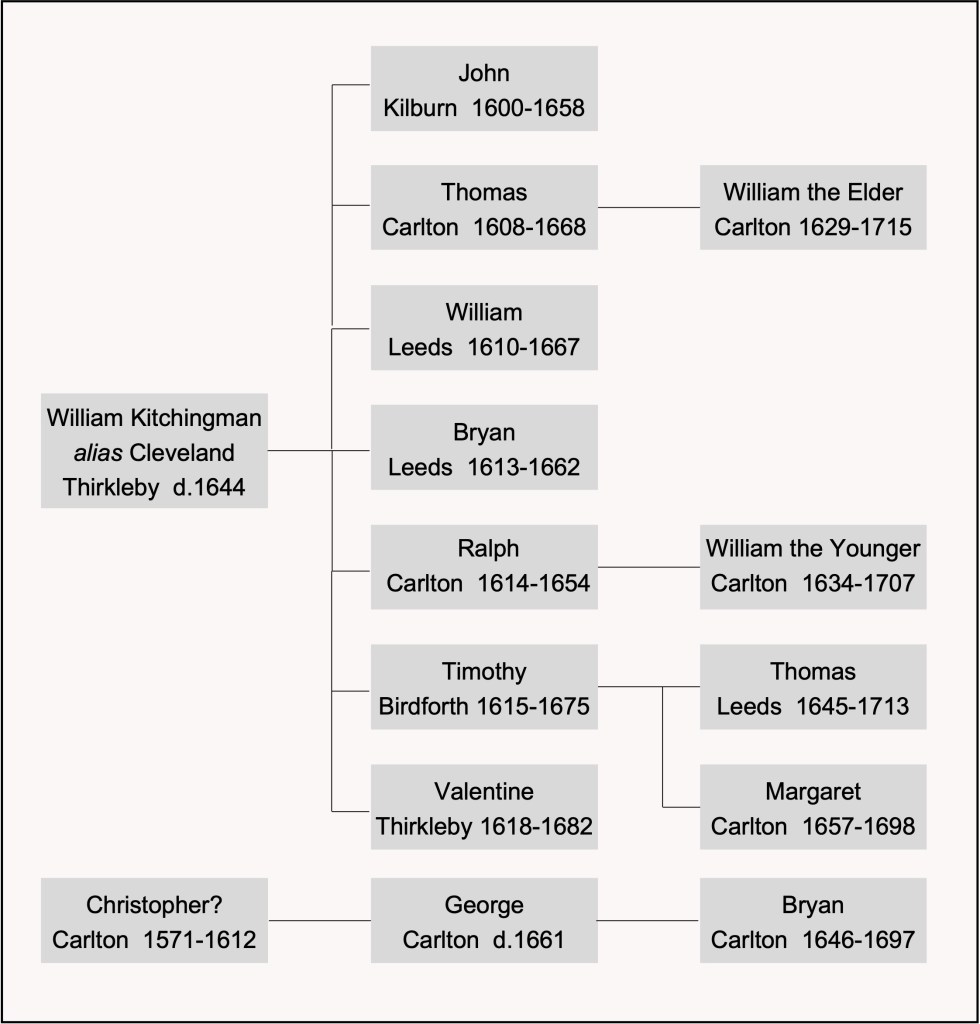
Selected Kitchingman pedigree, Parish Registers/Bishop’sTranscripts. NB Thomas was baptised in 1603 not 1608. 5
John, Thomas, Ralph, Timothy and Valentine were set up with farms of about 60 or 70 acres each. Although modest by today’s standards, they were large enough to employ labour and market their surplus in neighbouring towns. Mark Overton has estimated that a yeoman with 100 acres could not only feed his family but also generate a profit of about £70 in a typical year (equivalent to about three years’ wages for a skilled tradesman). Collectively, the Kitchingmans held over 200 acres in Kilburn alone throughout the seventeenth century. Profits were re-invested in securing copyhold tenancies for future generations, purchasing freehold land, or providing portions (dowries) to settle advantageous marriages, of which, more below. 6
What of the other two sons?
Premiums were paid to arrange apprenticeships for them in the burgeoning woollen cloth trade in Leeds. William and Bryan subsequently became successful clothiers. In a period before banking or formal investment opportunities, it is highly probable that their ventures were funded by loans from their country kinsmen, who shared in the rewards. Social as well as economic capital may have played a part in their success. Their likely kinsman, Richard Kitchingman, was also established in Leeds as some sort of attorney, with connections to the wool trade (see My Best Hat).
By 1662, Bryan had been appointed one of the Assistants (councillors) of Leeds Corporation. His will, written in the previous December, included mention of extensive property in Meadow Lane and Hunslet, bequests to the vicar and poor of Thirkleby, as well as a suit and £10 to his apprentice and nephew Thomas (the son of Timothy K of Bagby). 7
By 1700, Thomas, along with his siblings, cousins and their children, would create what has been called Leeds’ most important dynasty of wool merchants. Their number included two Mayors and three Alderman. Civic duty appears to have happily coincided with family enrichment. 8
A good marriage could be another source of improved circumstances. Above the door to Carlton House are carved the initials “BK 1674”. This was the year Bryan married Jane Bell of Cundall; her portion/dowry likely helped pay for the building of their new house. 9
Likewise, the building of Sunny Bank coincided with the marriage of George Cooper and Margaret K in 1676. They died within two years of each other, leaving behind four under-age children. George’s will of 1699 placed his estate in trust for them with Thomas K of Leeds, “his loving brother”. When Thomas’ son Thomas died in 1715, he left five guineas to “my kinsman”, his cousin William Cooper, who had gone on to become a clothworker in Leeds. 10
William K the Elder of Carlton also married well. His first wife was a cousin to some degree, Jane K, the daughter of William K of Petergate, York. Her father had risen to become Master of the Merchant Taylor’s Company and briefly Sheriff of the city (see Where Papists Lodge?). Jane’s brother, yet another William, was an attorney, who would later serve as Clerk to the Council for over 20 years. This was clearly a highly lucrative role. In 1659, he was able to buy Baxby Manor next to Husthwaite for £1600 and an annual rent of one peppercorn. In 1674, the Town Clerk paid tax on 19 hearths in the Minster Yard (only three houses in York were larger). 11
It seems likely that these connections helped William K the Elder and William K the Younger in their business ventures, although it is not yet clear what form these took. By the 1680’s, they had bought land and manors near Pontefract and returned to their new houses in Carlton bearing the title “Mr”, the first step towards gentrification. 12
In addition to the kinship ties outlined above, it is worth noting another factor that contributed to their success: their longevity. Most lived until the age of sixty, so had a full lifetime to make their way in the world. Subsequent generations would not be so lucky.
A version of this blog was first written for the Husthwaite Local History Society newsletter. It owes a great deal to Professor Stuart Marriot’s ‘Carlton Husthwaite – The Houses of the Old Village Since the 17th century’. Stuart also generously shared with me his unpublished research into the Kitchingman family and answered my endless queries. My thanks also to Angela Ovenston of the Society for her support and encouragement.
References
- S. Marriot, ‘Carlton Husthwaite – The Houses of the Old Village Since the 17th Century’, (Carlton Husthwaite, 2010), https://www.husthwaitehistory.co.uk/assets/Carlton_Domesday.pdf
- K. Wrightson, ‘Countries and Nation’, Lecture 5, Early Modern England, (Yale, 2009), https://oyc.yale.edu/history/hist-251 .
See also C. Phythian-Adams, Rethinking English Local History, (Leicester, 1987), pp. 20-26, for discussion of the “society of the pays” as one possible unit of study. Analysis of Kitchingman marriage-horizons may be a fruitful avenue for future analysis – see B. Maltby, ‘Easingwold Marriage Horizons’, M. Drake (ed.), Population Studies from Parish Records, (Matlock, 1982), pp. 36-39, for a neighbouring town as a comparator. - North Yorkshire County Record Office, CRONT 1454, Hearth Tax for Birdforth & Bulmer Wapentakes 1673, (Ripon Historical Society, 1991).
For Kilburn and Wildon Grange, see Borthwick Institute of Archives, University of York, Diocesan Archives: ‘Árchbishop’s Sharpe’s MSS’, Vol. II, (1693-99), BP.Dio 2 Account for Manor of Kilburn; CC Ab 5.5. - For land in Bagby, see W. Brown (ed.), Yorkshire Archaeological Society, Yorkshire Deeds, Vol II, (Leeds, 1914), p. 20. For land in Balk, see W. Brigg (ed.), Yorkshire Archaeological Society, Yorkshire Fines for the Stuart Period, Vol I, (Leeds, 1915), p. 215.
J. C. Atkinson (ed.), North Riding Record Society, Quarter Sessions Records, Vol. 1, (London, 1884), pp. 136, 142; Vol II., (London, 1884), pp. 42, 158, 205, 246; Vol III (London, 1885), pp. 194, 262, 330. https://archive.org/search?query=%28north%20riding%20quarter%20sessions%29
Borthwick Institute of Archives, University of York, Diocesan Archives, Cause Papers, CP.H.1794, (1628-29), https://www.dhi.ac.uk/causepapers/causepaper.jsp?id=98498; CP.H.5416, (1640), https://www.dhi.ac.uk/causepapers/causepaper.jsp?id=103706.
W. P. Baildon, ‘Compositions for not Taking Knighthood at the Coronation of King Charles I’, Yorkshire Archaeological Society, Miscellanea, Vol I, ‘(Leeds, 1910), pp. 84-102, https://archive.org/details/YASRS061/page/106/mode/2up. For context, see H. H. Leonard, ‘Distraint of Knighthood: The Last Phase 1625-1641’, History, Vol 62, No. 207 (1978), pp, 23-37, https://www.jstor.org/stable/24410394.
North Yorkshire County Record Office, Little Thirkleby Manor Court Roll, TBCF - Borthwick Institute of Archives, University of York, Diocesan Archives, Parish Registers/Bishop’s Transcripts for Birdforth, Coxwold, Easingwold, Kilburn, Husthwaite, Leeds St Peter (West Yorkshire Archive Service Leeds), Thirkleby.
- S. Marriot, op. cit & unpublished research.
Borthwick Institute of Archives, University of York, Diocesan Archives: ‘Árchbishop’s Sharpe’s MSS’, Vol. II, (1693-99), BP.Dio 2 Account for Manor of Kilburn; CC Ab 5.5.
M. Overton, Agricultural Revolution in England, (Cambrige, 1996), pp. 20-21.
See also A. Shepard and J. Spicksley, ‘Worth, age, and social status in
early modern England’, Economic History Review, Vol. 64, No. 2 (2011), pp. 493-530, for an interesting analysis of the increasing prosperity of yeomen during the sixteenth and seventeenth centuries, with an almost tenfold increase in worth from 15050-74 to 1625-49 https://www.jstor.org/stable/pdf/41262433.pdf?refreqid=fastly-default%3A4056061cbacda96d61bfe81a453917c2&ab_segments=0%2Fbasic_search_gsv2%2Fcontrol&origin=&initiator=search-results&acceptTC=1 - J. G. Clarke (trs.), The Court Books of the Leeds Corporation, January 1662-August 1705, (Leeds, 1936), p. 1.
Borthwick Institute of Archives, University of York, Diocesan Archives, Prerogative Court of York Wills, Volume 45, Folio 7, Bryan Kitchingman of Leeds, proved 7 July 1662. - J. G. Clarke, op. cit.
J. W. Kirby, ‘The Alderman of Leeds (1626-1700)’, M. W. Beresford et al, Leeds in the Seventeenth and Early Eighteenth Centuries, (Leeds, 2008), https://archive.org/details/thoresby044/page/n7/mode/2up, pp. 103-104. Kirby repeats the mistake in Thoresby’s Ducatis Leodiensis, (1715), https://archive.org/details/b30459242, pp. 258-259, which reproduces a pedigree suggesting that John K of Thirkleby was the founder of this dynasty; parish registers confirm that it was in fact William K als Cleveland.
R. G. Wilson, Gentleman Merchants, (Manchester, 1971) pp. 15, 150, 244-245. - S. Marriot, op cit.
Borthwick Institute of Archives, University of York, Diocesan Archives, Marriage Bond between Bryan Kitchingman of Carlton Husthwaite, yeoman and Jane Bell, 14 October 1674. - S. Marriot, op cit.
J. W. M. Clay, Yorkshire Archaeological Society, Paver’s Marriage Licences Vol III, 1674-1714, (1912), p. 22, https://archive.org/details/paversmarriageli00churv46/page/n29/mode/2up: George Cooper, yeoman, 28, Carlton and Margaret Kitchingham [sic], spinster, 22, Balke.
Borthwick Institute of Archives, University of York, Diocesan Archives, Parish Register/Bishop’s Transcripts for Husthwaite: Margaret Cooper buried 24 September 1699; George Cooper buried 20 October 1699.
Borthwick Institute of Archives, University of York, Diocesan Archives, Peculiars Probate Index Box 1 Set 47, will of George Cowper of Carlton Husthwaite, 8 October 1699, witnessed by William, Richard and Robert Kitchingman.
National Archive, Country Apprentices 1710-1808, 43 f 97, 1713 William Cooper master, clothworker of Leeds, apprentice John Fothergill of Ripon, premium £25.
Borthwick Institute of Archives, University of York, Diocesan Archives, Prerogative Court of York Wills, Vol. 70, folio 52, Thomas Kitchingman, 22 March 1714. - Borthwick Institute of Archives, University of York, Diocesan Archives, Parish Register of Holy Trinity Goodramgate, 4 October 1650 (also noted in Husthwaite Parish Register).
See for details of Jane’s father William.
Jane’s brother William appears to have been apprenticed to Sir Robert Barwick, Recorder of York of Newton Kyme . He acted as his attorney in a Deed of Partition in April 1651, Hull University Archives U DDSY/80/7 and as a witness for him, age 22, of Toulstone (next to Newton Kyme) in a 1655 court case over a disputed rabbit warren, H. Speight, Lower Wharfedale, (London, 1902), pp. 322-328.
William’s election as Town Clerk was disputed and required the confirmation of King Charles II, following a testimonial by Viscount Fauconberg:
P. M. Tillott (ed.), A History of the County of York: the City of York, (Victoria County History, London, 1961), pp. 173-186, https://www.british-history.ac.uk/vch/yorks/city-of-york/pp173-186;
F. H. B. Daniell, Calendar of State Papers Domestic of King Charles II, January-November 1671, (London, 1895), pp. 282, 290, 293, 294, 308, 350, https://archive.org/details/sim_great-britain-public-record-papers-domestic-charles-ii_january-november-1671/mode/1up?view=theater.
E. Smith and S. Marriot, Aspects of Baxby, (Husthwaite Local History Society, 2016), pp. 19-20.
Indenture of Sale, 1679, Sheffield Archives, Yorkshire Deeds, MD789. Signatures of William K father and son helped to confirm their relationship based on other manuscripts. George K, presumably of Carlton, was another witness.
Hearth Tax Digital, The Returns of the City of York for Lady Day 1674, Minster Yard, Mr Wm Kitchingman, 19., While possible that this was an official residence of the Corporation, it seems unlikely that it would be located in the Minster Yard, given the fierce rivalry between the City and Dean and Chapter during this period. See S. Marriot, Peterhold, (Carlton Husthwaite, 2012). - For example, Borthwick Institute of Archives, University of York, Diocesan Archives, Bishop’s Transcript of Husthwaite, 10 January 1681 baptism of William son of William Kitchingman Snr. Gent.
 Early Modern Kinship
Leave a comment