My best hat
On Monday, 16 July 1635, Richard Kitchingman of Halifax made his will. It vividly conveys his close relationship with his kinsfolk, as well as a considerable level of detail about his sartorial tastes. 1
Richard’s first concern was the £100 he had invested with his brother in law, Edmund Hinde, “by him used in trading for my use and profit”. He left this to his “dear and loving wife” Elizabeth, desiring her to leave it with Edmund at the rate of eight per cent.
We know from other sources that Edmund was a cloth merchant of Briggate, Leeds. In 1627, he married Cecily Kitchingman, Richard’s sister. 2
His wife Elizabeth also received the rent for her life of a cottage in Halifax (her residence on their marriage in 1632), the residue of the estate and was made sole executrix.
Richard then left a further forty and three score pounds to his “little daughter Anne”. This too was in the hands of Edmund, due to Richard for the very recent sale of lands in Tadcaster and Shadwell. Again, he wished the money to remain with Edmund at eight per cent, until Anne reached the age of twenty one.
If Anne died before twenty one, the £40 was to go to Elizabeth and the £60 to be split between his siblings Cecily and John of Shadwell.
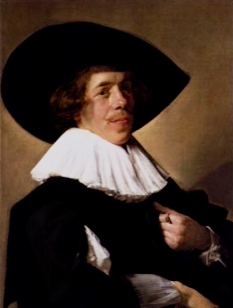
Franz Hals, Portrait of a Man, 1630-33,
Gemäldegalerie, Berlin.
His investments taken care of, Richard left forty shillings to Mr Henry Ramsden, Vicar of Halifax, hoping that he would preach at his burial. Ramsden was a fellow of Lincoln College, Oxford, well-known for his “edifying and Puritanical sermons” and this perhaps reveals something of Richard’s own religious preferences. 3
The will then becomes somewhat rambling, as Richard called to mind his personal estate.
Edmund Hinde was a close friend as well as business partner. Richard left him his black colt at Shadwell “desiring him to keep him for my sake”, “my black silke garters”and “my best suit of apparel”.
To Edmund’s son John, he bequeathed “my litle coat that I wear to make him a coat of”, as well as “all my lawe bookes, Lattin bookes, indentures, papers and parchements”. Since John was only three years old at the time, the latter were clearly intended by his uncle as a gift for the long term.
Richard was probably in his thirties when he made his will and both his parents were still alive , though unnamed in the will. To his mother, he left a piece of new broad cloth and a piece of “Sadd coloured bayes”. To his loving father, he gave “my cloak and my best hat”.
His brother, John of Shadwell, received “my green cloake Sadd coloured jerkin and tawney breeches” and hackney saddle. Richard also forgave him “all the mony he oweth me”.
To John Ryall, brother of his wife, he gave “my best hatt but one my black doublet and breeches” and “two of my best bandes”.
Richard also gave “my loving Ant Snedall forty shillings in gold to buy her a kirtle with desiring her to be good to my little daughter as she hath always been and to be content with this finall legacie as a [- -] of my love”. Mrs Ann Snidall was buried at Halifax in 1638, perhaps an aunt of his wife’s who had helped with child care? 4
Finally, Richard forgave a bond for twenty nobles owed by Edward Harrington. This may have been the goldsmith and freeman of York fined in 1635 by the Goldsmiths’ Company of London for sub-standard plate. 5
The next day after making his will, Richard Kitchingman was buried at Leeds St Peter. His daughter Anne died in May the following year. In August 1636, his widow Elizabeth re-married to Thomas Smith, a mercer, and with the more common name disappeared from view. His nephew John Hinde survived until the age of eighteen but is unlikely to have made much use of the law books left to him. 6
Richard’s will is noteworthy for three reasons.
First, on his death bed he remembered nine different family members, including an account of capital invested and debts owing. While the language of affect may be no more than conventional, his bequests are much more extensive than might be expected from orthodox accounts of the primacy of the nuclear family and of kinship ties as narrow and shallow. 7
Secondly, it shows the difficulty of pinning down a man’s occupation in this period. The will does not state Richard’s profession. Although his marriage licence and a surviving bond have him as a yeoman, this may have simply been a statement of his status (he came from a long line of yeomen in Shadwell). The reference to law and Latin books suggests that he may have been some kind of attorney, clerk or scrivener, probably trained through apprenticeship. This is supported by his witnessing various legal transactions for West Riding citizens. 8
Thirdly, the will is very unusual in its detailed account of the apparel of a man of the middling sort. Clothing was one of the most costly items of expenditure in the seventeenth century, yet is infrequently mentioned in wills. For example, the Costume Historian blog notes that in a set of 900 wills from Sudbury from 1630-35, only 14% make any mention of clothes. From a much larger data set, only 0.5% refer to the colour of a main garment. The colours of the complete outfit given to his brother John may be of particular interest to costume historians. 9
Was Richard’s wardrobe an attempt by an itinerant attorney to look the part or “dress to impress” as he rode around the West Riding? Possibly. We are left with the enduring impression that this was someone, whatever his religious outlook, who took real pleasure in what he wore.
References
- Borthwick Institute for Archives, University of York,York Diocesan Archive, Prerogative Court of York Wills, Vol. 42, Folio 704, Richard Kitchingman of Halifax, proved 9 February 1635.
- West Yorkshire, England, Church of England Baptisms, Marriages and Burials, 1512-1812, Leeds St Peter, marriage of Edmund Hynde and Sisely Kitchiman of Shadwell, 27 December 1627.
See also baptism of son John, Leeds St Peter, 17 March 1632. - J. H. Turner, Biographica Halifaxiensis, Vol I, (London, 1883), p116.
- Bishops Transcripts, York Diocesan Archive. Borthwick Institute for Archives, University of York, Halifax, burial of Mrs Anne Snidall, 29 July 1638.
- 1 noble = 6s 8d.
http://coneystreetheritageproject.org.uk/the-craftsmen-and-women/jewellers-and-watchmakers - Bishops Transcripts, York Diocesan Archive. Borthwick Institute for Archives, University of York, Halifax, burial of Anah Kitchinman, daughter of Richard,29 July 1638.
Paver’s Marriage Licences from the Registry of York, Vol I 1630-1644, Thomas Smith, mercer, and Elizabeth Kitchingman, Halifax, widow – at Halifax, 23 August 1636.. - A. MacFarlane, The Family Life of Ralph Josselin : An Essay in Historical Anthroplogy, (Cambridge, 1970) p. 157 ff, and K. Wrightson and D. Levine, Poverty and Piety in an English Village, Terling, 1525-1700 (1995 revised edition) pp. 91-99 and pp.192-4 are the seminal works of this orthodoxy.
W. Coster, Kinship and Inheritance in Early Modern England: Three Yorkshire Parishes, (York, 1993), https://archive.org/details/kinshipinheritan0000cost/page/9/mode/1up , tends to support the orthodox view, finding bequests to extended kin in only single digit percentages in his analysis of 424 wills. Coster makes the important point that the extent of bequests was dependent on wealth, status, life stage, and demographic structures pp. 9-24.
R. T. Vann, ‘Wills and the Family in an English town: Banbury 1550-1800’, Journal of Family History, Winter 1979, found evidence of stronger kinship ties.
A number of unpublished PhD. theses have provided further insights into Early Modern will making, including: S. J. Appleton, ‘Women and Wills in Early Modern England: The Community of Stratford upon Avon, 1537-1649’, (University of Birmingham, 2016) https://etheses.bham.ac.uk/id/eprint/7611/1/Appleton17PhD.pdf; M. D. Riley, ‘Families and their Property in Early Modern England: A Study of Four Communities on the Yorkshire Ouse 1660-1760’, (University of York, 1990) https://etheses.whiterose.ac.uk/4246/1/DX093164.pdf; G. Heley, ‘The material culture of the tradesmen of Newcastle upon Tyne 1545 -1642: The Durham probate record evidence’, (University of Durham, 2007) http://etheses.dur.ac.uk/2642/
K. Wrightson, ‘Mutualities and Obligations: Changing Social Relationships in Early Modern England’ , Proceedings of the British Academy 139, (2006) https://www.thebritishacademy.ac.uk/documents/2030/pba139p157.pdf provides a much more nuanced view than Wrightson’s earlier work. - See C. W. Brooks, Pettyfoggers and Vipers of the Commonwealth, (Cambridge, 1986) for an excellent account of how different kinds of men could offer legal services in the Early Modern provinces pp. 30-47.
For examples of Richard witnessing deeds, see: Hull History Centre, University of Hull, papers of the Wickham-Boynton Family of Burton Agnes: U DWB/3/31, 15 September 1628; U DWB/3/34, 13 July 1633; Yorkshire Archaeological Society Journal, Vol III, ‘Local Muniments’, p. 70, 16 March 1630, https://archive.org/details/yorkshirearchae01unkngoog/page/70/mode/1up. - M. Spofforth, ‘The Cost of Apparel in Seventeenth-Century England, and the Accuracy of Gregory King’, The Economic History Review, Vo,. 53 No. 4, (Nov 2000), https://www.jstor.org/stable/2598600
P. Poppy, ‘Colours of clothing in the first half of the seventeenth century’, Costume Historian, (2017) http://costumehistorian.blogspot.com/2017/04/colours-of-clothing-in-first-half-of.html

 Early Modern Kinship
Leave a comment