Origins
Around 1300, patrilinear surnames began to emerge in northern England. By 1500, most fathers passed on their names to their children and subsequent generations through the male line.

According to dictionaries of English surnames, the name Kitchingman had occupational origins: a person working in a kitchen. More specifically, it has been suggested that it is derived from someone working in a monastic kitchen. Given that the name was most commonly found in Yorkshire and the large numbers of medieval monasteries in the county, this is not implausible. Byland Abbey, for example recruited monks and lay brothers from surrounding local villages such as Kilburn. 1
As would be expected in the medieval and early modern period, there were many variant spellings of the Kitchingman name, although this eventually became the dominant form. These included Kyttchyngman; Kychynman; Kechynman; Kitchinman; Kitchenman; Kitchiman; Kytchman and Kitchman. It was and remains a rare name, with the ‘Oxford Dictionary of Family Names’ counting a total of less than 450 bearers for the variants in the 1881 census. 2
The earliest record found to date is from 1325. Ricardo Kychnman of Stayngreve (Stonegrave), about six miles from Helmsley in the North Riding of Yorkshire, was taxed at twelve pence in Edward III’s Lay Subsidy roll. The tax was calculated at one twentieth of moveable goods and intended for the defence of the realm against the Scots. 3
In 1346, Willo Kitchinman of Collingham, near Wetherby in the West Riding, was assessed for two shillings under the Lay Subsidy. 4
The 1379 poll tax captured other Kychynmans and their wives in various villages between Tadcaster and Leeds: four Williams; two Johns; Robert; Beatrix; Hugo; Roger, Thomas and Walter. 5
In 1457, we have the first mention of Carlton Husthwaite in the North Riding, with Richard and his wife Alice granted lands near Newburgh. This transaction led to a long-running dispute with the Prior of Newburgh. 6
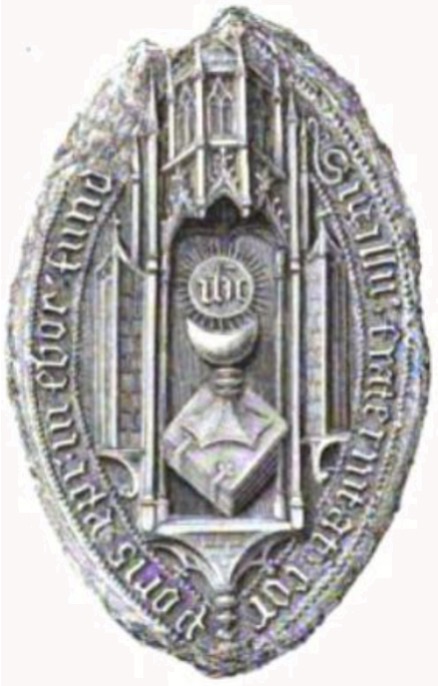
In 1475, John Kytchinman, chaplain of Keldholme Priory (about seven miles east of Helmsley), was defending a suit for debt. The same John, along with Thomas Kechynman and his wife, were members of the Corpus Christi Guild in the City of York in the 1470’s. This very large fraternity included religious, as well as lay men and women. John was recorded as Dom. (Dominus) and Cap. (Capellanus) or chaplain. 7
In 1480, Peter Kitchinman was recorded as one of the ten Wakemen of Ripon, a role eqivalent to alderman in cities with royal charters. 8
Nicholas Kitchinman, labourer, became free of the City of York in 1485, as did John Kechynman, cobbler in 1493. 9
Three Yorkshire clusters
By 1500 then, three distinct clusters were emerging, located in:
- villages south of the Howardian Hills in the North Riding, particularly around Carlton Husthwaite;
- villages between Tadcaster and Leeds in the wapentake of Skyrack in the West Riding, particularly around Shadwell;
- and within the city of York itself.
These early records are, unsurprisingly, fragmentary and there is no genealogical proof of the relationship between the groups. However, given their limited footprint within a 25 mile radius of York, it seems probable that they shared common ancestry. Hey and Redmonds make a similar point about the 1674 Hearth Tax returns, suggesting that DNA testing could resolve the question of whether or not all the Kitchingmans are related. 10
The same authors, along with the geneticist Turi King, have conducted a multi-disciplinary study showing that the rarer the surname, the more likely it is that its bearers will share common ancestry:
“If a surname is of a frequency below 5,000 bearers, the probability of two same-surnamed men sharing a common ancestor through that surname is nearly 50%.” 11
It should be noted that the passing on of the Y chromosome type to male children can be disrupted by what are rather coyly described as “non-patrilineal events”. These include illegitimacy, adoption or maternal transmission of surname and the use of aliases. 12
Migration and distribution
The conventional view is that early modern families stayed in their own country, within about ten miles of home. Exceptionally, large numbers of individuals sought their fortune in London. 13
From parish records, this would appear to be true of the Kitchingmans around Shadwell. For almost 400 years, many remained in the immediate area, as noted on the large slab gravestone of Samuel in the churchyard of St Peter, Thorner. 14
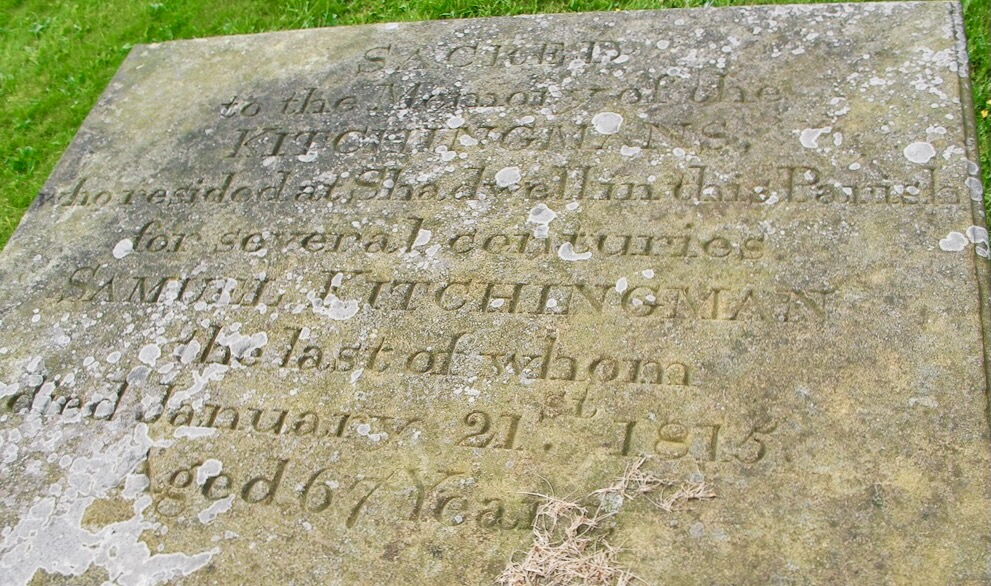
“Sacred to the memory of the Kitchingmans, who resided in Shadwell in
this parish for several centuries. Samuel Kitchingman the last of whom
died January 21st 1815 aged 67 years.”
Yet their story is more complex than this suggests.
A branch of the Kitchingman family appeared in the sixteenth century in East Anglia. The precise link to the Shadwell branch is uncertain but revealed in the 1624 will of Clement Kitchingman, a draper of Norwich. He left twenty shillings each to his cousins John Harrison of Tadcaster and his sister Anne to buy rings. Cousin was used loosely to describe different relationships, including nephews and nieces. This pair seem to have been children of Constance Kitchingman who had married John Harrison, an innkeeper. Constance also appeared as a child in the 1558 will of Richard Aked of Tadcaster, receiving 6s 8d. 15
Clement’s younger son, John ,stayed in Norwich and became a prosperous wool merchant. His eldest son George moved to London, where he borrowed £50 from his uncle Thomas, a mercer with dealings in Ireland, where some of his children settled. 16
The North Riding branch spread themselves across Yorkshire to Leeds, Calderdale, Whitby, Ripon and Pontefract, as well as London. 17
Over the next three centuries, some lines ‘daughtered out’ or died out completely. Those in the West Riding proliferated and spread into the North West textile areas. By the 1881 census, the distribution map below shows that these had become by far the most numerous.
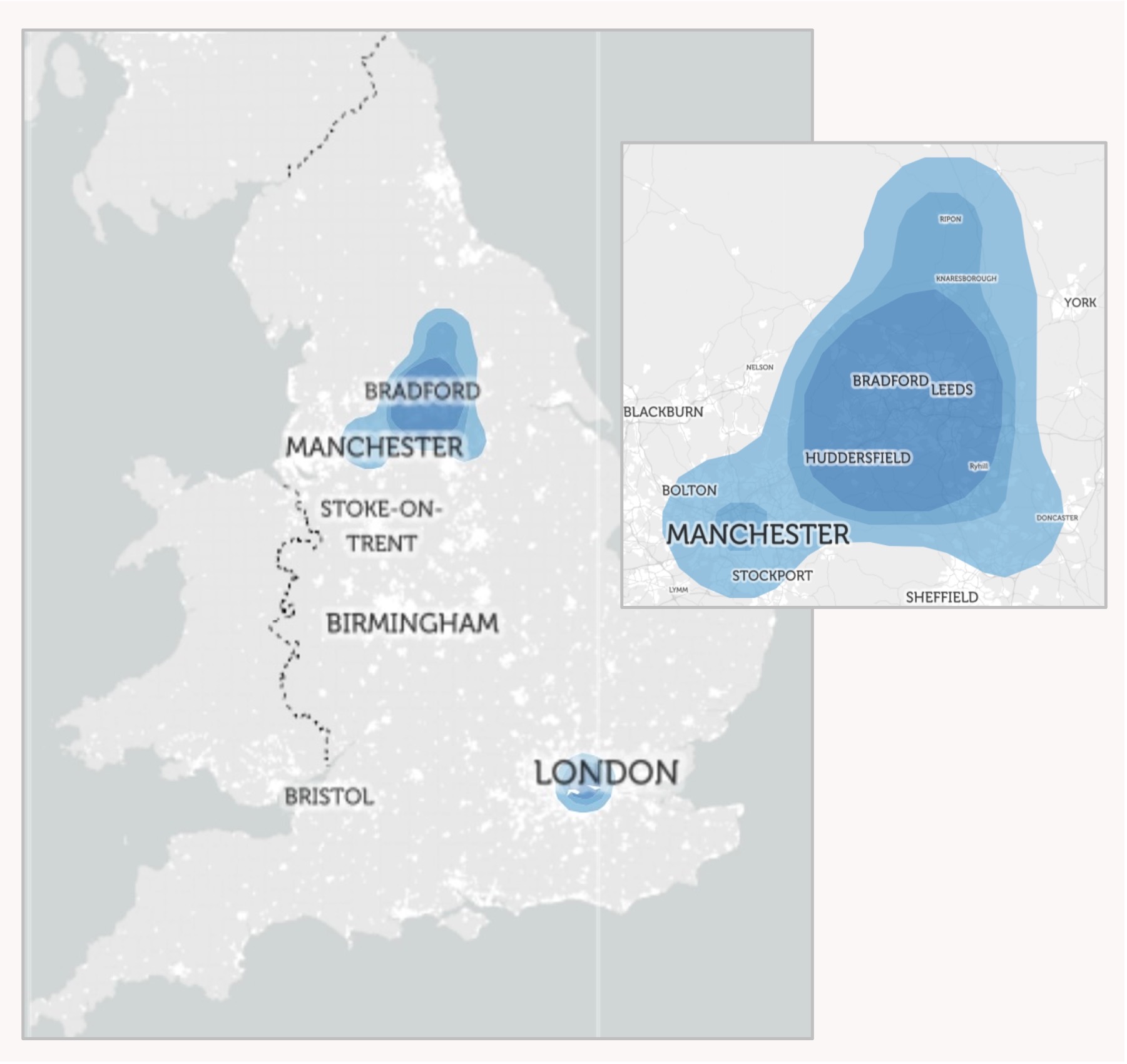
Kitchingman Distribution Map, 1881 Census, based on 291 bearers and population weighted density. Images courtesy of CDRC, University College London.
Then as now, the primary motivation for migration was economic. The Kitchingmans were not landless labourers seeking a living as servants in husbandry. As scions of the middling sort, they were looking for opportunities to better themselves and make their fortunes. Nor were they all younger sons forced to make their own way, while their eldest brothers inherited the family farm. In several cases, such as William K of Halifax, it was the eldest son who left home. 18
Detached branches and exceptions
From the beginning of the seventeenth century, a further kinship group is to be found in what we would now call South Yorkshire, around Wath upon Dearne. From the available records, there is no evidence to date that they ventured far afield or had any interaction with the other branches. 19
In Sussex and Kent, there were a large number of Kitchenhams. Their name is derived from a small hamlet, in East Sussex near Battle, which appears in the Domesday Book. Nothing to date suggests any connection with the Yorkshire clan. Confusingly, there is evidence that Kitchenham became conflated with Kitchingman, particularly when they moved to London. The artist John Kitchingman appears to be descended from this line. 20
Finally, out of over 3,000 data points, there are only a handful of examples of Kitchingman being varied to Kitchen or Kitchin. This may seem surprising but it may be that the hard ending of “man”, particularly spoken with a Yorkshire accent, avoided that confusion.
Postscript
Although the precise link between the families of Shadwell and Norwich appeared elusive, it has been supplied by the 1620 will of Peter Kitchingman. Peter was a single man, so had no wife or children to whom he could leave his estate. Helpfully, he named 20 different family members, including his brothers Clement of Norwich, Thomas of London and Richard of Shadwell and their children. 21
Richard was the eldest son of John Kitchingman of Shadwell (1523-1592). Clement became a freeman of Norwich in 1587, by purchase or order of the Council rather than apprenticeship. 22
For the family historian, these fragments provide invaluable proof of genealogical relationships. More broadly, they indicate the survival of kinship ties across generations even when separated by several days’ travel.
References
- P. H. Reaney & R. M. Wilson, A Dictionary of English Surnames, (London, 1991), p. 267, “A derivative of OE cycene ‘kitchen’, one employed in a kitchen, especially a monastery”. https://archive.org/details/dictionaryofengl0000rean_f3p9/page/267/mode/1up?q=kychynman
Richard Kitchingman quoting conversation with one of the Heralds c.1996, ‘Papers Relating to Kitchingman Family of Yorkshire’, Brotherton Library, University of Leeds, YAS/MS1592.
C. Cross and N. Vickers, Monk, Friars and Nuns in Sixteenth Century Yorkshire, (Yorkshire Archaeological Society, 1995), pp. 3, 98-99. https://archive.org/details/YASRS150/page/2/mode/1up?q=BYLAND - P. Hanks et al, The Oxford Dictionary of Family Names in Britain and Ireland, (Oxford, 2016),
p. 1492, https://archive.org/details/oxford-dictionary-of-family-names-in-britain-and-ireland-2016/page/1492/mode/1up?q=kychynman - Yorkshire Archaelogical Society Record Series, Vol. 74 :Miscellanea Vol. II, ‘Poll Tax 2 Edward III, 1327, (Wakefield, 1929). p. 116, https://archive.org/details/YASRS074/page/116/mode/1up
- J. Stansfeld, “Two Subsidy Rolls of Skyrack Temp. Edward III’, Thoresby Society, Miscellanea, Vol. II, Part II, (Leeds 1890) p.92.
https://babel.hathitrust.org/cgi/pt?id=njp.32101063965246&seq=174 - All taxed at a modest 4d. ‘Rolls of the Collectors in the West Riding of the Lay Subsidy (Poll Tax) 2 Richard II, Wapentake of Skyrak’, Yorkshire Archaeological Journal, Vol 6, (London, 1881),
pp. 310-324. https://archive.org/details/YAJ006/page/310/mode/2up - W. Brown (ed.), Yorkshire Archaeological Society Record Series Vol. 50: Yorkshire Deeds Vol II, (London, 1914), p. 147. https://archive.org/details/YASRS050/page/147/mode/1up
J. S. Purvis, Yorkshire Archaeological Society Records Series Vol. 88: Monastic Chancery Proceedings Yorkshire, late 14th century to 1540, (Wakefield, 1934), p.97. https://archive.org/details/YASRS088/page/97/mode/1up?q=MONASTIC+CHANCERY+PROCEEDINGS+YORKSHIRE+%221486-93%22&view=theater
See also National Archives, C1/151/118 Latover v Kychynman, (1486-93). The Prior eventually appealed to the Archbishop of Canterbury. - National Archives, Court of Common Pleas plea rolls, CP40/853, side 1 f.81, (Hilary 1474).
See Anglo American Legal Tradition, for image: http://aalt.law.uh.edu/AALT2/E4/CP40no853/aCP40no853fronts/IMG_0081.htm
R. H. Skaife, The Register of the Guild of Corpus Christi in the City of York, Surtees Society,
Vol 62., (Durham, 1872), pp.80, 96. https://archive.org/details/registerofguildo00guilrich/page/79/mode/1up?q=kychyman - The History of Ripon, (London, 1806), p.23. https://archive.org/details/historyofriponwi00farr/page/22/mode/2up?q=kitchinman
- D. Collins (ed.), Surtees Society Vol. 96, Registers of the Freemen of the city of York, Vol. 1, (Durham, 1897), pp. 211, 219. https://archive.org/details/registerfreemen01collgoog/page/n233/mode/1up
- D. Hey and G. Redmonds, Yorkshire Surnames and the Hearth Tax Returns of 1672-73, Borthwick Paper No. 102, (York, 2002), p.13. https://archive.org/details/yorkshiresurname0000heyd/page/n4/mode/1up
- B. Redmonds, T. King and D. Hey, Surnames, DNA and Family History, (Oxford, 2011), p.177.
- B. Redmonds, T. King and D. Hey, ibid, p. 173.
- See for example, P. Spufford, ‘Population Movement in Seventeenth Century England’, Local Population Studies, Number 4, (Spring, 1970), p. 148. http://www.localpopulationstudies.org.uk/PDF/LPS4/LPS4_1970_41-50.pdf
- Mr. Samuel Kitchingman, husbandman, buried 30 January 1815, aged 65, St Peter’s, Thorner, Samuel was baptised at Mill Hill Prebyterian Chapel in August 1749, West Yorkshire Archive Service, ‘West Yorkshire, Non-Conformist Records, 1646-1985’, f.177.
His ancestry can be traced back through parish and other records to John Kitchingman of Shadwell who made his will in February 1591, the grandfather of Richard Kitchingman featured in My best hat - National Archives, PROB 11/153/79, Will of Clement Kitchingman, Draper of Norwich, Norfolk, 22 May 1624, probate granted 28 January 1628.
Borthwick Institute for Archives, University of York, PR-TAD-1, f.60: Constance, the wife of John Harrison the Innkeeper, buried 19 April 1616.
G. D. Lumb (ed.), Testamenta Leodiensia. Wills of Leeds, Pontefract, Wakefield, Otley and District 1553-1561 , part 2, (Leeds, 1930), p. 193. https://archive.org/details/thoresby009/page/193/mode/1up?q=CUSTANCE - National Archives, PROB 11/305/106, Will of George Kitchingman, Tallow Chandler of Saint Mary Whitechapel, Middlesex, 5 May 1659, probate ganted 12 July 1661. George was a fascinating character , whose occupation was actually a silk weaver. I will blog on his story at a later date.
National Archives, PROB 11/179/422, Will of Thomas Kitchinman, Mercer of City of London, 20 November 1638, probate granted 20 February 1639. Thomas left an extensive trail in the records, including of his dealings in Ireland. - See Four houses in Carlton Husthwaite and Died very rich? for Leeds and Calderdale. I will blog on the Whitby, Ripon and Pontefract branches in due course.
- See Died very rich? for biography of William Kitchingman of Halifax.
- The earliest Kitchingman records in Wath upon Dearne date from the beginning of the seventeenth century with the baptisms of the children of William and Grace. For example, Borthwick Institute for Archives, University of York, Diocesan Archives, Bishop’s Transcripts, John the son of William Kitchinman baptised Wath upon Dearne, 1600.
- John Kitchingman, c. 1740-81. See for example: E. Edwards and H. Walpole, Anecdotes of painters who have resided or been born in England : with critical remarks on their productions, (London, 1808), p.76. https://archive.org/details/anecdotesofpaint00edwa/page/76/mode/2up?q=kitchingman
- Norfolk Record Office, Consistory Court Wills Registers, Vol 118, ff.99-100, will of Peter Kitchinman of Norwich, 19 May 1620, proved 13 September 1623. https://www.familysearch.org/ark:/61903/3:1:3Q9M-C39Z-C3MR-V?view=fullText&keywords=Kitchinman&lang=en&groupId=TH-909-82209-81190-94
- Borthwick Institute for Archives, University of York, York Diocesan Archives, Prerogative Court of York Wills, Vol 25, f.107, will of John Kitchingman of Shadwell, 20 February 1591, proved 6 Decemeber 1592.
P. Millican, The Register of the Freemen of Norwich 1548-1713, (Norwich, 1934), p.128. https://www.familysearch.org/ark:/61903/3:1:S3HT-D4K9-K15?view=fullText&keywords=Kitchingman&lang=en&groupId=M9S7-7WJ
 Early Modern Kinship