
Misteries of a marriner
Some time in the 1660’s, a young man called John Kitchingman climbed the steep escarpment at the edge of the Hambleton Hills.
Below, sat the farmland of Thirkleby, Kilburn and Carlton Husthwaite, home to his family for countless generations. Ahead, lay the waste of the North York Moors. Beyond that, would be the port of Whitby and his first sighting of the unending sea.
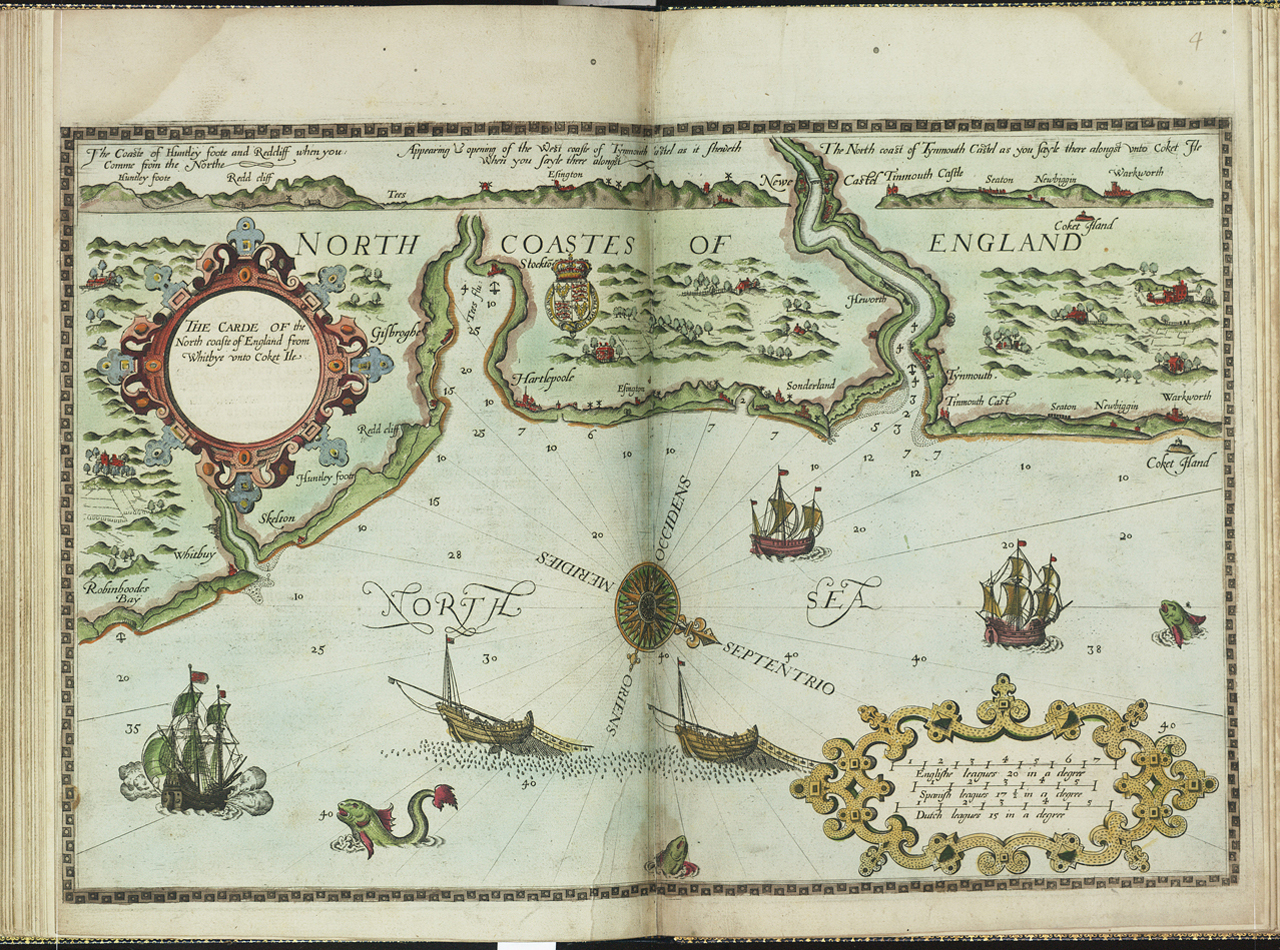
The Carde of the North coaste of England from Whitbye unto Coket Isle, from Anthony Ashley’s English edition of ‘The Mariners Mirrour’ by Lucaz Jans Waghenaer, c. 1588.
© National Maritime Museum, Greenwich, London CC BY-NC-ND
John was born in 1649. His seven year apprenticeship into the “misteries of a marriner” began some time after the death of his father Valentine in 1662. 1
John would have begun his new life as a sea servant, carrying out domestic duties on board and running errands for the master in port. Once strong enough, he would quite literally have learnt the ropes. Progression could quickly follow to mariner, then mate, then master. The most able and well connected could become masters in their twenties. 2
Whitby in the late seventeenth century was a boom town, on its way to becoming England’s sixth largest port outside London. Its “broad-bottomed, blunt-bowed” ships primarily carried coal from Newcastle to London. However, Rosalin Barker has argued that the catalyst for the growth of Whitby’s fleet was the emergence of the town’s alum industry. Alum was essential to fix dyes in textiles. 3
Our first sight of John at work comes from this trade. In October 1679 a ship called the Hester was driven ashore in Whitby haven “by the presse of weather or violence of sea”. John helped unload and reload her cargo of alum, before sailing with her for London as “foremast” man. We know this because the ship’s ownership was later disputed in the Admiralty Court at York, between her master, John Moone, and Matthew Shipton, whose family managed the alum works at Lythe. John gave evidence on Moone’s side.
Shipton’s brother told the court that John and Moone were “very intimate”, and that Moone had afterwards sold John a ketch, hinting at a quid pro quo for false testimony. 4
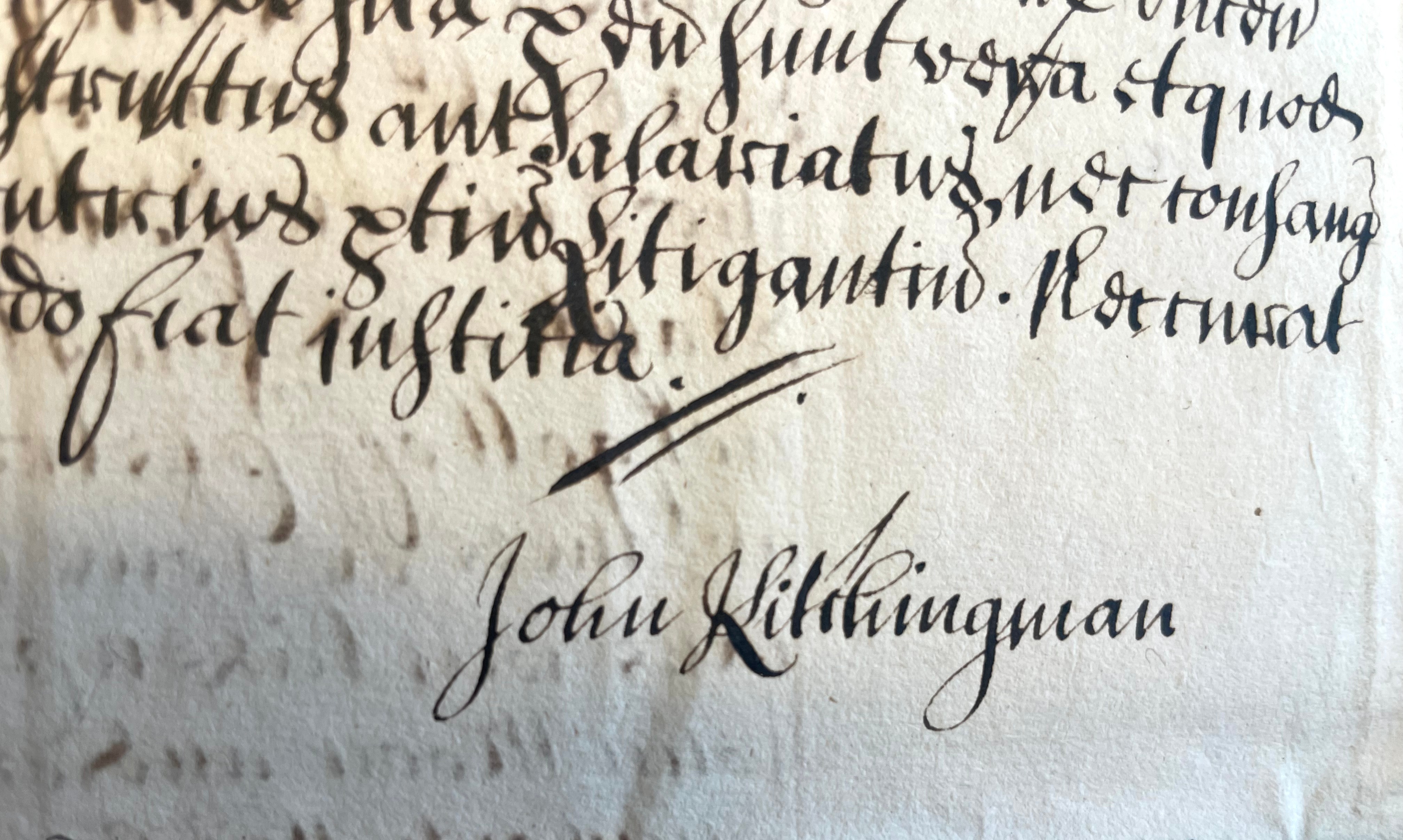
The confident signature of John Kitchingman from his deposition in Shipton c. Moone, 1680, Admiralty Court Cause Papers. From an original held at the Borthwick Institute of Archives, University of York.
One moiety or half of a ketch
On 12 April 1680, John agreed to buy half of a ketch called the Advice of Whitby, “burthen of one hundred tuns or thereabouts”, then lying at anchor in the haven. The price was £200. The seller was John Moone, “a Rich man and a great Master and dealer in shipps”. 5
The very next day John married a young widow Mary Hope. It may be that she contributed to the purchase. Together, they had four children over the next eight years: Elizabeth, John, William and Anne were all baptised in the church of St Mary the Virgin, high above the town next to the ruined Abbey. 6
It’s hard to imagine a more hopeful spring for a man starting out in life. It did not last.
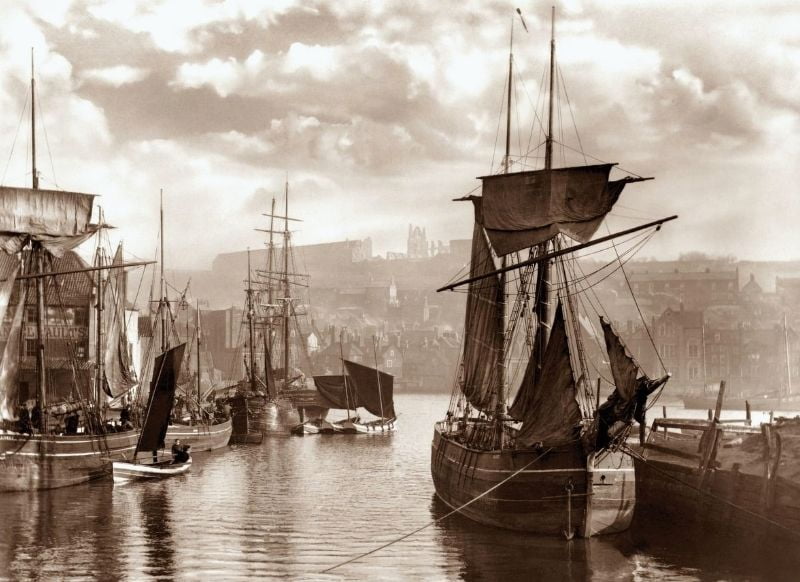
Dock End, Whitby, c.1890, by Frank Meadow Sutcliffe, in a scene probably little changed for over 200 years. The vessel in the foreground is a ketch, like the Advice of Whitby. Image: wikimediacommons.
Hope unravelling
To begin with, things went well. John made voyages to Holland as master, buying goods there on Moone’s behalf. Then two promises in the bill of sale began to come apart.
First, Moone had undertaken to “acquitt cleare and free the said shipp from all debts troubles and Arrests” (a standard contractual term). Yet within weeks, old debts from before John’s purchase caught up with the Advice. A Whitby butcher sued John for beef and repairs supplied in the 1670s, and the ship was arrested and kept in harbour. Another arrest was made by Moone himself, for £107 he said was owed for repairs and stores. 7
Secondly, Moone was to “adventure the other half”, with John as sole master. But Moone did not own the other half, only one sixteenth. The rest belonged to others: his siblings Jonathan and Margaret Moone and Matthew Shipton. According to Moone, they would not let John take the ship to sea, finding him “a man dilatory or negligent in his business and very defective in giving in his accounts”. 8
What followed was a decade of litigation.
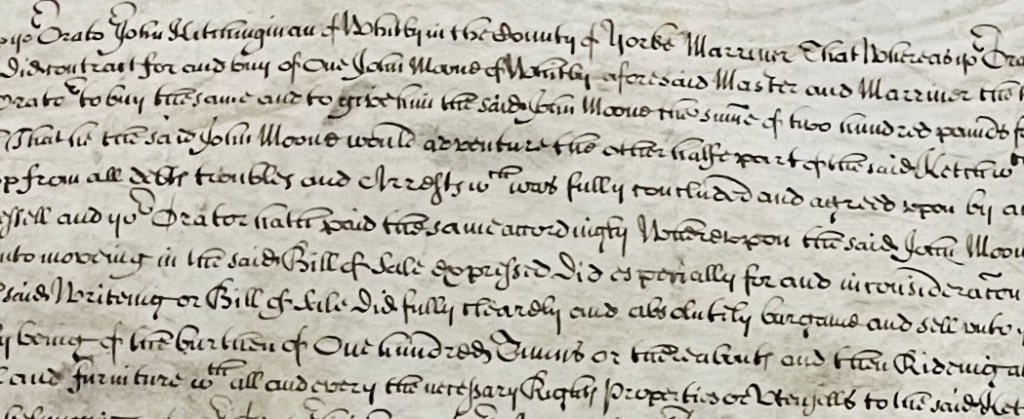
Detail of the complaint of John Kitchingman, National Archives C10/142/55 Kitchingman v Moone, 1681, © The National Archives.
John took Moone to the Chancery Court in 1681 and again in 1682, complaining that his house had been “broke up” and goods seized, and that Moone threatened to “cast him into Prison”. At the York Assizes in March 1682, a jury found for John and awarded him £200. Moone refused to pay until bailiffs seized £23 10s of his goods in October 1683 and he handed over the remaining £176 10s. 9
To settle all matters of difference
In August 1683, Moone and his brother-in-law rode thirty miles to Carlton Husthwaite, to the house of William Kitchingman the Elder, gentleman (most probably the new house described in Four Houses in Carlton Husthwaite.) He asked William to receive the money on John’s behalf and to bring the quarrel to an end. William agreed to help “out of the respect that he bore to the said Complt Moone’s wife & her relations”. 10
William was John’s first cousin and an attorney. He was also, as it turned out, part-owner of the Advice. Nobody seems to have thought this disqualified him. When the parties bound themselves in £400 in the following March to accept William’s award, Moone himself declared that “in regard he the deft William was part owner thereof he was a fitter [man] to be Arbitrat[or]”. 11
William heard witnesses at York and from the parties at Helmsley. He also took the papers to his neighbour and MP for Thirsk, Sir William Frankland of Thirkleby. On 1 May 1684, the day the award was made, William went to Frankland’s house, where Moone was waiting. The two gentlemen “walked into the Garden for above an houre” while William outlined his adjudication. 12
In a later deposition, Frankland described William as:
a person of a good reputation in his Country & of a good knowledge & understanding, a man of worth and of a considerable estate, a very charitable kinde gentleman, a lover of peace and often concerned in reconcileing controversyes and makeing agreements amongst such as were att variance. 13
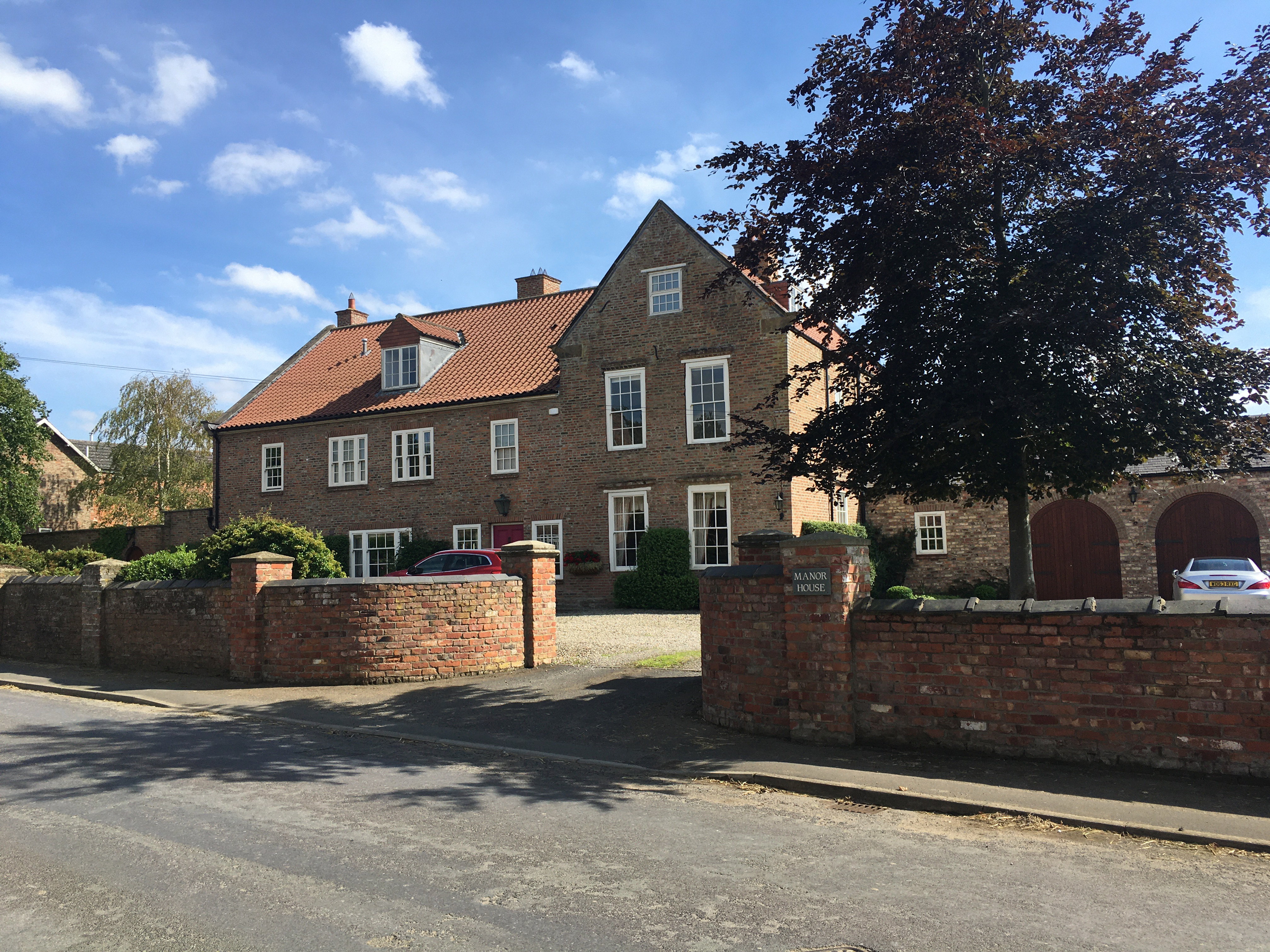
The house built by William Kitchingman the Elder in Carlton Husthwaite, later known as the Manor House.
William’s judgement was that Moone was to pay John £320 in three instalments; while John was to hand over the ship’s sails and tackle. The latter were not inconsequential, valued at £47 in a comparable case. 14
Deeply dissatisfied, Moone called William “a Judge in his own Cause” on account of his part ownership of the Advice. He refused to pay, so John sued on the bond. At the York summer Assizes of 1684, the case came before Sir George Jeffreys, then Lord Chief Justice (later the “hanging judge” of the Bloody Assizes). William gave evidence and handed the judge the paper setting out his award. The verdict again went for John. Once again, Moone refused to accept it and went back to Chancery. Once again, he was unsuccessful and ordered to pay the sum awarded, plus interest and costs. 15
Kinship as capital
The National Archives often catalogues cases like these under the bland description “money matters, Yorkshire”. While accurate as far
as it goes, this misses what the richness of these records themselves makes plain. These were not impersonal business disputes. Almost everyone involved was a neighbour, a friend, a cousin, a brother or an in-law.
It also misses where the money came from.
John was a young mariner, probably with little capital of his own. Yet he had bought half a ship, plus an 1/8 more from Jonathan Moone, 10/16 sixteenths in all. Part of the answer lies in a single sentence from the depositions. William’s wife Rachel, said that Moone knew before the arbitration that William “who lives att Carleton was part owner of the vessell”, and
that one William Kitchingman of Hallifax another of the deft John Kitchingman’s Cousins was part owner alsoe, and severall other of his relations. 16
William of Halifax was in fact John’s elder half-brother, a successful clothier. William of Carlton had paid £26 for his 1/16. 17
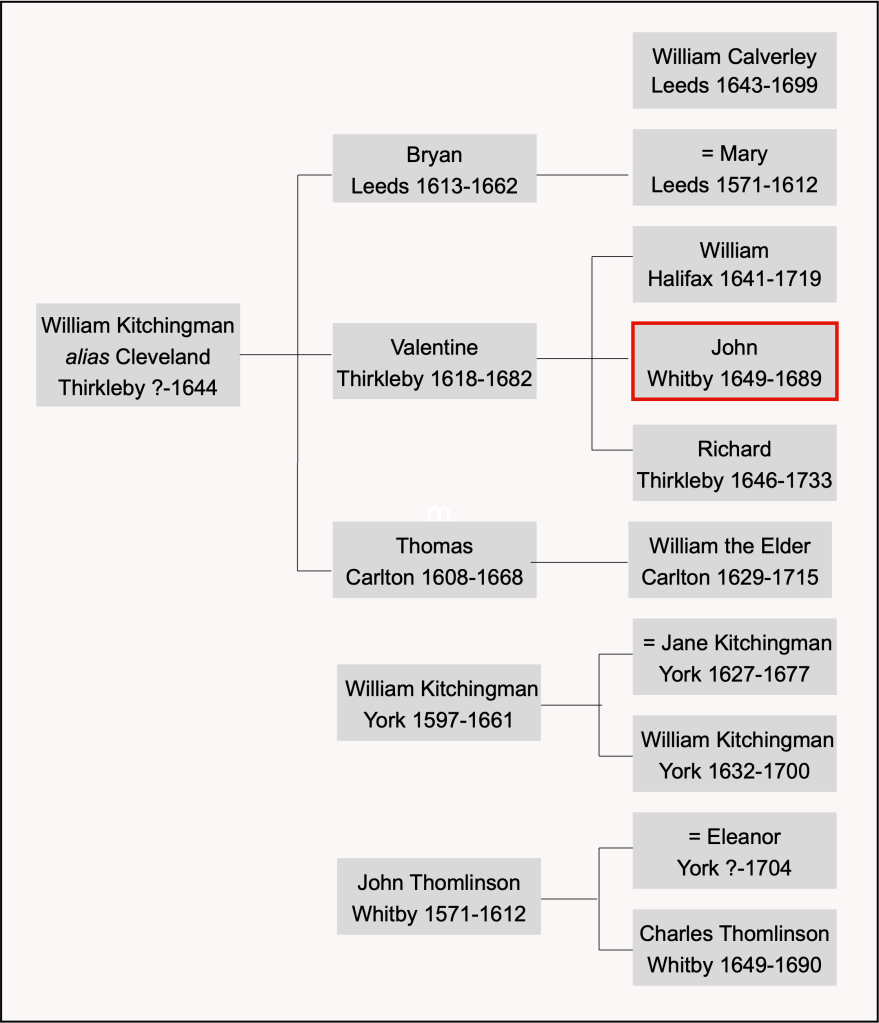
Selected pedigree of kinship network involved in the legal disputes. The relationship between Wiilliam the Elder of Carlton and Jane Kitchingmans of York is uncertain but they were likely to be cousins to some degree.
In other words, John’s purchase seems to have been largely financed by his family, taking fractions at cost. Spreading risk across many small shareholders was normal practice for ships. What is striking here, is that the shareholders were kin. Decades later, William of Halifax still owned a 1/16 of a Whitby ship, the Mary & Martha; the inventory of Thomas Kitchingman, alderman of Leeds, recorded profits of £49 12s 1 1/2d on ships mastered by John’s sons John and William K. 18
Kinship supplied social as well as financial capital. It provided the arbitrator, the receiver of the money, the witnesses and the lawyers. When John needed help to fight Shipton in 1687, he turned to William Calverley of Leeds, an attorney of the King’s Bench and husband of John’s cousin Mary. Calverley was also one of the commissioners who took William and John’s answer in 1684, and Mary’s in 1693. Even on Moone’s side, the attorney who stood surety for him, Charles Tomlinson of Whitby, was the brother-in-law of yet another William Kitchingman the town clerk of York, who just happened to be the brother-in-law of William Kitchingman the Elder of Carlton. 19
The end of the matter?
John Kitchingman was buried at Whitby on 1 January 1688, “Mr. and Mariner”, and not yet 40. He died intestate with Administration of his estate granted to Mary in March. 20
The matter did not end with him. In January 1691, the ever-litigious Moone sued Mary, “his widdow and Relict”, claiming that satisfaction had never been entered on the old judgements. A fortnight later she married John Harrison, another Whitby mariner. More than a year after that, in April 1693, commissioners came to Whitby to take her answer. She said that John had not left “assetts sufficient” to pay his debts, calling herself “a poore widdowe and putt to this unjust and vexatious Charge”. 21
Finally, William Calverley sued Mary, her new husband and Richard Kitchingman of Thirkleby, another of John’s brothers, for his unpaid legal fees. According to Calverley, John’s assets included chattels, gold plate and parts of ships – a different account than he had used to defend Mary. 22
It is worth adding up what all this cost. Over thirteen years, John and his family were caught up in at least ten actions in the Admiralty Court, Chancery in Westminster, Common Pleas and the York Assizes. Bills had to be drafted in London, and commissions sent out and returned. There were journeys to York, Helmsley, Thirkleby and Carlton; witnesses to feed and lodge; bailiffs, bonds and bail; and fees for attorneys, clerks and counsel at every stage.
For a master mariner, every month in court was a month not at sea. Whatever John gained from William’s award and the verdict before Jeffreys, it is hard to believe he came out ahead. For him, and for Mary, the dispute must have been all-consuming.
Spare a thought too, for John Moone. He died in 1695 in his bed with silk hangings, possessed of considerable lands but only £90 in goods and 1/32 of a shallop, a very small boat. Perhaps unsurprisingly, his will anticipated conflict between his heirs. 23
Despite all of their troubles, John and Mary Kitchingman founded a sea-faring dynasty. Both their sons became master mariners in their turn. And for the next 150 years, other Kitchingmans in the words of Psalm 107, went down to the sea in ships. 24
Their stories are for another post.
References
- John was baptised at Thirkleby on 18 May 1649, North Yorkshire County Record Office, Baptisms, marriages & burials: Thirkleby, PR/TK 1/1, p. 18,
His father, Valentine, yeoman, was buried on 25 March 1662, North Yorkshire County Record Office, Baptisms, marriages & burials:Thirkleby, PR/TK 1/2, p. 16.
In his will, Valentine left John his child’s portion of £10 (possibly used for his apprenticeship premium), Borthwick Institute for Archives, University of York, York Diocesan Archive, Prerogative Court of York Wills, Vol. 46, folio 54, dated 18 January 1661, proved 24 October 1663. See Frequenter of Conventicles for the story of John’s half brother William.
The Kitchingmans had connections in Whitby through the marriage of Eleanor, daughter of the Whitby alum merchant John Thomlinson, to William K who became Clerk to the York Corporation. He, in turn, was brother in law to William K the Elder of Carlton Husthwaite.
The starting date of John’s apprenticeship is uncertain. Extensive analysis of London apprenticeship records suggests that the average age was over sixteen: P Wallis et al, ‘Leaving Home and Entering Service: The Age of Apprenticeship in Early Modern London’, LSE Working Papers 125/09, (LSE, 2009), p. 27 https://www.lse.ac.uk/Economic-History/Assets/Documents/WorkingPapers/Economic-History/2009/WP125.pdf
During the two or three winter months, when ships were laid up for repair, apprentices would have attended school in Whitby. Evidence from the early eighteenth century shows that apprentices studied navigation, pilotage, nautical law, astronomy, rigging, maintenance and the provisioning of vessels. Master mariners had to be numerate and literate: negotiating with factors when buying stock and with lightermen when unloading cargo; keeping the ship’s log, as well as accounts for its owners.
The title of this post is taken from a case in the North Riding Quarter Sessions at Helmsley on 18 January 1680, when one of John Moone’s apprentices sought to be released on account of ill-usage by his master: J. C. Atkinson ed.), North Riding of Yorkshire Quarter Sessions Records, Vol. VII, (London, 1889), p.46. https://archive.org/details/quartersessionre07grea/page/45/mode/1up?q=+%22John+moone%22 - For a detailed account, based on one ship’s voyage book, see R. Barker, ‘Thomas Rogers and the Judith of Whitby; the Voyage Accounts of a Seventeenth Century Merchant Ketch’, The Northern Mariner, XVII No. 3, (July 2007), pp. 19-39.
See also R. Barker, ‘Cook’s Nursery: Whitby’s Eighteenth-Century Merchant Fleet’, G. Williams (ed.), Captain Cook: Explorations and Reassessments, (Woodbridge, 2004), pp. 14-20.
See also the introduction to Henry Simpson’s splendid Work Book from 1711 on the Whitby Museum website https://whitbymuseum.org.uk/henry-simpsons-work-book-1711/
H. Taylor, Memoirs of the Principal Events in the Life of Henry Taylor, (North Shields, 1811), pp.1-33 provides a vivid first hand account of a maritime career beginning in about 1750. https://www.google.co.uk/books/edition/Memoirs_of_the_Principal_Events_in_the_L/dUQBAAAAQAAJ?hl=en&gbpv=1&printsec=frontcover
J, C. Beaglehome, The Life of Captain James Cook, (Stanford, 1974), pp. 5-14 contains insights into his apprenticeship aboard Whitby Colliers. https://www.google.co.uk/books/edition/The_Life_of_Captain_James_Cook/mIk8x6lsusQC?hl=en&gbpv=1&printsec=frontcover
R. J. Blakemore, ‘Life at Sea’ in J. Davey, Tudor and Stuart Seafarers, (London, 2018), pp. 190-197 is a beautifully illustrated account of the period. - R. Barker, The Rise of an Early Modern Shipping Industry, (Woodbridge, 2011), pp. 128-139. Barker provides a comprehensive account of Whitby’s fleet from 1600-1750.
S. K. Jones, ‘A Maritime History of the Port of Whitby 1700-1914’, (University College London, unpublished PhD. thesis, , 1982), p. 43 shows that, based on Trinity House records. Whitby accounted for the third highest number of vessels (98) employed in the Newcastle coal trade in 1705. See also pp. 82-83.
Voyage books show that Whitby also regularly sailed to Amsterdam, Dunkirk, Hamburg and Stockholm, with cargoes including timber, iron, wines and spirits, grain and, during wartime, troops.
R. Barker, op. cit, pp. 24-27, 82-83. Alum was the product of a lengthy industrial process, requiring coal and urine brought in by ship to transform the aluminous shale, quarried from the cliffs at nearby Loftus, Ravenscar and Sandsend.
For an account of the early alum industry, see The Whatman’s and Wove Paper, http://www.wovepaper.co.uk/alumessay1.html and M. E Challloner, ‘Alum Extraction Around the North York Moors’, https://www.nyma.org.uk/_webedit/uploaded-files/All%20Files/History%20Tree/16%201867%20Alum%20Extraction%20around%20the%20North%20Yorkshire%20Moors.pdf - Borthwick Institute for Archives, University of York, York Diocesan Archive, Admiralty Court, Shipton c Moone 1680. The surviving documents are some of the most extensive in the fragmentary records of the Admiralty Court. This cause prefigures in many respects the later dispute between Kitchingman and Moone. In fact, the dispute was three-cornered, though the records are incomplete.
National Archives, C 10/142/55: by July 1681 Moone had heard that Shipton, with Jonathan and Margaret Moone,, had brought actions against John for their share in the Advice.
National Archives, C7/61/26 Calverley v Kitchingman: In Easter term 1687, Shipton had John arrested in Common Pleas for £200, although thanks to the intervention of Calverley, the bail bonds were set aside. No record of the actual Common Pleas proceedings has yet been found. - National Archives, C10/142/55 Kitchingman v Moone, 1681, bill and answer.
Although the bill of sale itself is dated 27 March 1680, Moone’s answer dates the bargain as “on or about the twelfth day of April”. - North Yorkshire County Record Office, Baptisms, marriages & burials: Whitby St Mary the Virgin, N-PR-WH1-3, pp. 88, 9, 13, 9, 30, 132.
- National Archives, C10/142/55 Kitchingman v Moone, 1681, ( Kitchingman’s bill).
Borthwick Institute for Archives, University of York, York Diocesan Archive, Admiralty Court, Betson c. Kitchingman, 1680. - National Archives, C 10/142/55, Kitchingman v Moone, 1681, (Moone’s answer).
- National Archives, C 10/142/55; C 10/484/116 (bill, 5 July 1682); C 10/151/73 (“upon a tryall in March Assizes one thousand six hundred Eighty and two”; “one hundred Seaventy six pounds and ten shillings”). William Kitchingman’s deposition places the assizes “about March last was two yeares”, which suggests March 1682 Old Style.
- National Archives, C 22/272/13, Moone v Kitchingman, depositions taken in the country for the defendants (c. 1685): depositions of William Kitchingman of Carlton, gent, aged about 53, and of his wife Rachel. aged about 31.
- National Archives, C 22/272/13 , depositions of William Kitchingman and Sir William Frankland. of Thirkleby, BT, aged 46.
The evidence for William’s profession as an attorney is cumulative rather than explicitly stated: including his election as High Constable for Birdforth in 1652, acting as an attorney for the Archbishop of York in his Kilburn estates, and acting for Bryan and George Kitchingman in the enclosure of Carlton Common. - National Archives, C 22/272/13 (depositions of William Kitchingman and Sir William Frankland). Frankland was also Member of Parliament for Thirsk, https://www.historyofparliamentonline.org/volume/1660-1690/member/frankland-sir-william-1640-97
- National Archives, C 22/272/13 (deposition of Sir William Frankland).
- National Archives, C 22/272/13 (deposition of William Kitchingman).
For the value of a ketch’s sails and tackle, see J. S. Purvis, The records of the Admiralty Court of York, (York, 1962), p. 16: 1680 appraisal of the ketch Anne of Whitby, with J. Moone one of the appraisers. - For the trial at York: National Archives, C 8/349/39, Moone v Kitchinman, bill, docketed “14th January 1692” [1691 Old Style] (“the Sumer Assizes at Yorke which was in the year 1684”);
C 22/272/13, depositions of William and Rachel Kitchingman (“before my Lord Cheife Justice Jeffreys”).
For Moone’s subsequent bill in Chancery against John and William Kitchingman, see C 10/151/73 (23 October 1684). The outcome of the Chancery hearing, “before the then Lord High Chancellor of England”, is recited in Mary Kitchingman’s answer: C 7/232/17.
For Jeffreys, see for example P. J. Helm, Jeffreys; a new portrait of England’s hanging judge, (New York, 1967), https://archive.org/details/jeffreysnewportr0000helm/mode/1up - National Archives, C 22/272/13 (deposition of Rachel Kitchingman).
- National Archives, C 10/151/73 (plea of John and answer of William Kitchingman).
- John’s half brother William became a clothier in Halifax. He was joined by John’s brothers George and Bryan, who became a dyer and clothier respectively. For sources, see Frequenter of Conventicles and Died Very Rich?
National Archives, C 101/5069 Denison v Kitchingman., 12 November 1735: Inventory of personal items and stock in trade, securities, funerary expenses, list of receipts and disbursements of Thomas Kitchingman deceased, page 32. Thomas Kitchingman Junior was the son of Thomas Kitchingman, John’s cousin, who left Thirkleby and became a successful clothier, one of Leed’s merchant elite and mayor on two occasions. The profit on ships was a drop in the ocean of his very large estate.
National Archives, C 7/61/26, Calverley v Kitchingman; C 10/151/73; C 7/232/17.
On Charles Tomlinson and the Town Clerk of York, see note 1.
Paver’s Marriage Licences 1666, William Calverley, gen., 23 of Oulton to Mary Kitchingman, spinster, 19 of Leeds. Mary was the daughter of Bryan KItchingman, uncle to John Kitchingman who had migrated from Thirkleby to Leeds in the 1620’s. He became a successful clothier and one of 24 Assistants or burgesses to the Leeds Corporation. - North Yorkshire County Record Office, Baptisms, marriages & burials: Whitby St Mary the Virgin, N-PR-WH1-3, p.132, John Kitchingman buried 1 January 1689.
Borthwick Institute for Archives, University of York, York Diocesan Archive, Prerogative Court of York, Administration Bonds, 27 March 1689. - National Archives, C 8/349/39; C 7/232/17, Moone v Kitchingman, answer of Mary Kitchingman, widow, sworn 29 April [1693].
Borthwick Institute for Archives, University of York, York Diocesan Archive, Archbishop of York Marriage Licences Index, 33, 125 Mary Kitchingman, widow, married John Harrison by licence at Whitby St Mary, 26 January 1691. - National Archives, C 7/61/26, Calverley v Kitchingman.
- North Yorkshire County Record Office, Baptisms, marriages & burials: Lythe, N-PR-LY1-2, John Moone buried 21 April 1695
Borthwick Institute University of York, Prerogative and Exchequer Court of York Wills,
1389-1858, Will of John Moone, 18 March 1694. Inventory of John Moone of Whitby, Gent,
9 October 1695, totalling £90 excluding real estate. - Psalm 107, Book of Common Prayer, (1662), pp. 279-280. https://www.churchofengland.org/sites/default/files/2019-10/the-book-of-common-prayer-1662.pdf



Leave a Reply